Friday, August 01, 2008

Safety Software.

If you read my Experimental permit application ….


a)You won’t have insomnia and


b) you will realize that there is a 100% seperate safety computer box.


That safety box has not been necessary to test things up til now.  Now it is becoming the limiting item to be ready to hover. It receives commands from the flight computer, data from the GPS , data from the RC receiver and sends status to the main computer and commands to the catalyst valve.


 Diagjpg


Since this code needs to both be very reliable and well reviewed I’m taking my time on it. At this point the following is complete:


  • Drivers for all the hardware interfaces.

  • Parser for the GPS messages (as well as a no message received time out mechanisum)

  • Method for storing waypoints and  managing their validity.

  • Command parser interface between the Main flight computer and the IIP computer.(Last years version did not have this communications, but this years relies on the II computer to turn the cat valve on and off so the main flight computer needs to tell it when it wants in open/closed)

  • Valve driver.

  • Battery monitor.

Still to be completeed :


  •  Actual IIP code as outlined in the experimental permit application.

  • Test Harness code to run on the PC.

 TestBenchJpg


. After that is complete I need to hook it to a test harness and excercise it. The test harness will look like:


So I have to write a simulator that runs on the PC and flies the veichle around and out of the “box” its supposed to stay in and test what  the IIP computers response is. that will be a significat portion of me weekend. (We also hope to go out to the desert and test again this weekend.)

Tuesday, July 29, 2008

Very Strange...

I posted this graph a few weeks ago:


June14_data


The very strange thing is that the chamber pressure is 500+ PSI where the feed pressure is 250 or so. I believed I had a data collection anomoly. I do not. I just finished testing the pressure transducer and checking out the wireing and it is all correct. The calibration of the ggraph is also correct.


The mechanical schematic of my motor is:


ChamberResonant


So the only possible conclusion is that I have a resonant pulse jet with the check valves. I’m going to run it again with a lot higher pressure and higher time resolution pressure transducer in place.


Sunday, July 20, 2008

A Simple little thing..

We are running the main tank pressure on the vehicle at very close to the absolute minimum spcified by the FAA experimental vehicle strucural guidlines. Our design pressure has a safety factor of two, but our test pressure has a SF of 1.25.


What does this mean? It means that no human should be within the blast radius while it is presurized. This implies a remote actuated quick disconnect.


A simple thing in concept a whole afternoon in acutality. The Quick disconnect needs to be reliable, and rugged. Each time its actuated its going to fall from several feet into the dirt or onto concrete.


Here is the result:


Qdbusinessned


Qdotherend


Two Aluminum arms are hose clamped to the barrel of a normal penumatic quick discconnect. These arms are fastend to the nut at the front end of an aircylinder (Mcmaster carr 6498K171) The plunger of the air cylinder threads into the back side of a brass plug that has been taped to match the aircylinder rod end thread. The brass plug pushes on the brass Tee and the aluminum arms pull the QD free. It works really well and is almost insdstructable.


 Here is the totally bogus video tour.

Thursday, July 17, 2008

Telemetry, Software, GPS, and progress.

Sorry for the long delay in the blog posts, all is going well its just been a busy summer.

I’ve been doing embedded hardware/software development for a very long time. (More than 20 years) One of the things I’ve learned is that you NEVER ever ignore a glitch. Even a harmless glitch. If you don’t exactly understand why its weird, find out. I’ve had a long running glitch in the Helicopter systems telemetry. Since this is the same exact software base I’m going to use on the rocket I needed to hunt it down before I was willing to risk the rocket vehicle.

In our last outing to the desert we packed up to go home around sunset. In the haste to get going I set something very heavy on the telemetry suitcase and by the time we were off the dirt road it was crushed. It looked like a sturdy aluminum box, alas that was only an illusion. So since my last update I’ve rebuilt the telemetry ground station in a ,much sturdier Rugged Pelican case.

In the process of rebuilding that I’ve also been working to hunt down the telemetry glitches and to add a Differential GPS correction to the system by having a differential reference GPS receiver in the telemetry suitcase.

All of these pieces don’t seem like much but these sort of details all take time. So I have this all worked out. The Netburner/Coldfire cpu in the telemetry box automatically initialized the differential GPS receiver and starts sending these corrections over the telemetry link, while the helicopter send telemetry back to the telemetry box through the same link.

Getting all these pieces to talk and coexist without ANY glitches has taken me close to three weeks. Some of the problems on the way were Bad GPS antenna cable, misunderstanding the GPS manual on how to set up differential, dead Maxstream telemetry radio, incompatible Firmware revisions in the Radios, and feature creep in the helicopter where we were trying to send more data that the link could handle. I also took the 4th of July off to relax. I also spent some time cleaning up the helicopter code base as to make the rocket and helicopter more similar from a software standpoint.

I offered to write up the code for the helicopter project for a magazine and it looks like that will turn into a several article project. Probably only one of which will get submitted before the contest in October.

We hope to go out to the desert this weekend and finish welding the Tether Crane, we’ll probably go out Friday afternoon and spend the evening/ night welding as working in the day time is insane. (its supposed to be 103 Friday)

The news from the FAA is all good so far, our review is underway with only minor clarifications needed.

Lastly I’ve been talking to a company that might provide some sponsorship, its an almost ideal fit and I have high hopes. Sponsorship is not absolutely needed, but it would also be nice to extract some value from the “Unreasonable” effort.

Wednesday, June 25, 2008

Paperwork as Promiosed

My FAA application has been declared Complete Enough. You may read it here:http://www.rasdoc.com/FAApermit/Public_Permit90_2008.pdf


The really hard core can compare and contrast with last years here:


http://www.rasdoc.com/FAApermit/PermitSubmission.pdf


I’ve given up on my Video camera, last tyime I moved it away from the action and had it zoom in, it still cut off part way through the test. I’ve ordered a new HD camera from Amazon that uses all solid state storage. I have high hopes it will be better. Please note that in the last section of the video we were sweeping the throttle valve from 0 to 100% trying to map chamber pressure.  Video is Here


I reviewed my Data and I found two problems….


1)Only one of the three legs is properly feeding catalyst. This explains the early shutdowns.


2)The chamber pressure transducer calibration is wrong, as this is a 4:20ma transducer, and the zero is in the right place I don’t know what is wrong. I’ll have to do a pressure sweep.


Uncaled Data below:


June14_data 

Monday, June 23, 2008

FAA App is complete enough...

I’m back from my trade show in Fl, I hope to catch up on my Unreasonable data this week and publish results from last weeks test. I’ll also be posting my FAA application as it has beed deemed complete enough.


Sunday, June 15, 2008

Got home at 2:25 am

It was a 22 hour day. We went out to the desert and poured concrete for 6 hours then began rocket testing. We poured the anchors of our tether testing trapeesze, and helped finish the flame trench on the FAR large vertical test stand.


We did a short 15 second or so test fireing, at full throttle. We ran out of permangnate before we ran out of Peroxide. Other than a tie down problem during setup that was the only issue.


We then helped someone else setup a test (can’t talk about it).


After their test we tested our vehicle for longer duration, it was supposed to be a minute, but again we ran out of permangnate early, we need to adjust the permangenate flow down.


We tested throttling and vane actuation, everything worked it was a very positive test. I have video of the first test, the camera shutoff during the second test. I have had zero time to review anything as I have a plane to catch in 2 hours and I will be doing non-rocket business stuff until next week.


I’ll post data a video when I return.

Saturday, June 14, 2008

Its:445

I’ts 4:45 am I have the its to early pukeing feeling. We are going to the desert to test. The vehicle is 100% physically complete. Every bracket, valve, cable, screw, nut and bolt. I still have some software to do, but the physical part is done. If this were more than a static test we would probably not meet the crew rest rules.


I’v finished the revised application and submitted it. I expect it to be declared complete enough.


I’m out of town all next week, I’ll try to post results before I leave.


Monday, June 09, 2008

Paperwork Update...

The reason I could not origionally  publish this years application was because the location information was under NDA/uncertain. Now that Xprize has formally announced its not under NDA.


In the interim I received a letter from the FAA asking for some paperwork changes.


So now that the venue is now public the document needs revision. I hope to resubmit the application this week. When it is declared complete enough I will publish it like I did last year.


Monday, June 02, 2008

Something different....prizes

I’m sorry I have not provided much input in the last two weeks I’ve been working on a bunch of related issues, but not making much direct hardware progress.


I’ve seen much on-line discussion of the Google Lunar X prize. Its a cool prize and significant purse, but I think it pales in comparision to the briliance of the origional X-prize.


I think a good prize should have several charactoristics:


  1. It should seem like its possible to win a bunch of $. A prize that costs 15M to win 20M is not a prize. There were a lot of people that thought they could win the origional X prize for less than 2M, they were wrong, but it appeared at first blush like it was possible.

  2. When the winner is successful it should create a market. The origional Xprize kick started a rush to do suborbital tourisum.

  3. The rules should be very simple, the core concept should be a paragraph or less.

I think the world really needs a low cost access to orbit prize. The primary barrier to becoming a spacefaring civilization is the cost to orbit. The traditional players have no incentive to really change this.


Pauls Ideal Orbital prize:


  • 10M for the first group to orbit a reusable vehicle.

  • Must orbit at least 4 times above 100 km.

  • Must return intact.

  • Must repeat within one month.

Reusable means:


  • All stages are recovered and reused.

  • No more than 10% of the inert stage mass may be replaced.

  • The replacement/refurbishment does not cost more than 100K per flight.

Possible Modifications:


  • Change the amount to 25M and require it carry a single person. For the first of the two flights the person could be simulated. (IE record accelerations temps, pressures etc.. prove person could survive.)

  • Remove the reuseablity requirement and substitute a low cost requirement. IE a fullt accounted cost to build and launch the 2nd flight for less than $200K.

Enough pontificating for one day. Those of you who have followed my blog for a long time will know we lost our 15yr old dog in October. Last Friday we acquired a 3 month old puppy from the Hellen Woodward anmial shelter. I’ve spent the weekend playing with the puppy, I only built one rocket part all  weekend.

Sunday, May 18, 2008

Paperwork and other projects....

We tried to do a full up static test on the vehicle last Sunday and again on Tuesday. We had some valve electronics problems that were traced to a screw rubbing in a bad place and a dead, possibly overvotaged, servo motor. This last weekend we worked on the logistics issues at FAR and will continue to do so for at least two days this week.


Since my 90 second vehicle and notional and 180 second vehicle are less than identical we need to submit two seperate experimental permit applications. 90% of the 2nd application will be cut and paste, but we still need to submit two. I finished the 90 second application  and e-mailed and fed-xed it to the FAA. If anyone read last years application this one will look stuningly familiar. I will make the aapplication public at some point in the future. If I released it now I’d be violating at least one NDA. 


I must give special thants to my friend Carl at Flometrics that spent part of his weekend doing CFD work to help me get a Cd number for the vehicle and the containment calculations. If you need a fluid or flow engineers please call them. They do a lot of really cool stuff. I’ll post some of the cool CFD pictures in the next few days.


We have been working at this full tilt for almost 18 months straight and I’m getting a bit tired. Spending a full day in the Mojave at over 100F really takes it out of you. 

Friday, May 09, 2008

A Glimpse of scary little details...

I have not reduced the data from last weekends first static fire, but I know that we had a main valve calibration problem. Tonight I brought up the flight computer to work on the main valve calibration and I got prodigious quantities of magic smoke. (All electronics runs on magic smoke, if you let the magic smoke out it stops working.) This is scary on a number of levels. If the main flight computer dies in flight the vehicle is lost, so I start asking did I make a design error, did I have an assembly error? What caused the system to let out the smoke?  So I remove the computer from the vehicle and take it into my office/lab in the house and hook it up to the current limited power supply…. no smoke. The magic smoke happened inside a closed case so everything in the case smells so no clues there.


One by one I test the sub systems… Main CPU, OK,Vane control OK, GPS OK, IMU interface OK, Telemetry Radio OK, Servo drivers OK Pressure sensor power error not OK. So I examine the little sealed DC to DC converter component that provides this power and it is failed shorted with smoke /char marks under it. The good news is that this failure would not have caused a crash, a loss of  pressure transducer data, but not a crash.


This little power supply adds to the head room for the two wire pressure transducers. I use 2 wire 4 to 20ma transducers because of the reduced wiring, from the three wire transducers. The transducers need 10V minimum, since I run the into a resistor that makes 0–>5V from 0 to 20ma I need a 15V supply. I’d been running 11.1V to the Big tonegowa servos so I added a 5V isolated DC to DC to bring the voltage up to 16.1V. In past setups I’d added one very small sensor battery,  but this time I though I’d remove one more service item. The sad part is that this is not really necessary anymore. This time around the Vane Actuators need ~18V  so I already have a voltage rail, 18V that could drive these. The smoking power supply has been voted off the project.


I wired a sacrificial 1/8W carbon 20 ohm resistor between the sensor circuit and the 18V supply so I’m now good to go. If any of the transducers wiring gets melted and shorts to ground the 20 Ohm carbon resistor will act as a  fuse. Protecting the flight critical power rails.


We also learned another lesson tonight. With LOX you can be 100% sure its gone two days later, not so with peroxide. We ran the vehicle until there was noting but nitrogen coming out of the motor. Apparently this is not enough. When my son  removed the main valve it dumped peroxide on his jeans.  No harm done, but it was exciting for a second when he leaps up removes his pants and runs out of the garage heading for the garden hose… on the way by saying “make sure we there's no fire”  Fortunately none of the many fire extinguishers were necessary.  a few teaspoons of peroxide  makes for some excitement but in this case not much else.


This does say that our run tank and main valve is clean and properly passivated.

Wednesday, May 07, 2008

Starting the paperwork...

We do not yet have an offical contest date for the 2008 NG-LLC. If they hold it around the end of October like they did the prior two years we are rapidly comming up to the FAA experimental permit submission deadline. So for the time being I’ve switched from aluminum to documents as my development mediium of choice. I feel this will be a lot easier this time around as I’ve already been involved with the FAA permit process.


For fun a cool picture….the business end of the vehicle taken from the flame trench of the test stand….


BusinessEnd


And one taken from inside the block house by Charles Pooley of the partial throttle test….(the wind was really blowing…)


PartialThrottle

Saturday, May 03, 2008

A tiny bit of hardware...

The vehicle is 99% complete. The only part missing is the IIP shutdown safety system. The IIP shutdown safety system calculates the instantaneous impact point (IIP) and shuts the vehicle down if the vehicle leaves the assigned flight hazard box.  The vehicle has been transported out to FAR for a static test in the near future so I don’t have a complete vehicle picture. I do have a couple of detail hardware pictures…


Openbox


The electronics box lid off and lid on….


Closedbox


The box mounts on the side of the sphere at an angle and the GPS antenna mounts on the box so it is the highest thing on the vehicle.


Lastly a short video of the jet vanes moving.


Thursday, May 01, 2008

Quick update...

Having Dad here for two weeks has slowed progress, but not stopped it.Last weekend I managed to fabricate the cwenteral control box and it is now wired. The vehicle is now basically complete. We will do a full vehicle tied down static test some time in the next week or so. This should allow us to gather some vibration data on how the IMU and GPS react to rocket vibration. After that we should start testing within the month. Its getting perilously close to the hot season out in Mojave so time is getting short.


We also need to restart the FAA paperwork process so we can do some free flights.


Wednesday, April 23, 2008

Level of commitment...Budget and Life.

Level of commitment.


A Number of people have commented on how fast things are going together. I think this reflects on the number of hours we are putting in on the project. I worked 8am to 2am Saturday and  10am to 10:30 pm Sunday.  Monday I did a full day of work at NetBurner Then spent the evening organizing some of the electronics planning connectors etc.. I went to bed at the early hour of 10:30pm. Today I got up at 6:30 am and went into work to spend 2 hours building our control PCB’s under the surface mount microscope. I then worked till 1pm and took 1/2 day off to spend some time with my wife. (More on why later in the post) Then I worked from 7:00 pm to 11:30 making servo mounts. I will do it all again Wednesday. I’m a bit tired, but it feels good. For all of you who read the blog and are not working on some dream or project, turn off the TV and do it. It will feel better than anything you have ever done.


Budget


Last year we had some cash  set aside for the project, we used most of what was set aside. This year we are funding the project directly out of current income. Last year cost almost never figured into the project. If we needed a part or a tool we had it next day.This year we are much more cost aware. Things like building the SMT board myself instead of sending them to our prototype house to have them build them at $500 a pop.  Ordering the raw PCB’s with 5 day lead rather than 2 day etc…. Now in my primary day job we send a lot (more than a million $) of work to the PCB assembly house and I could call them up and say its a personal project and they would probably assemble them for free, but that is not how I do business. All business needs to be mutually beneficial and nobody makes money giving freebies. We have no budget issue with building two of this vehicle. The second vehicle we will lighten to the maximum extent possible. Based on our design info that may be enough to do the 180 second flight on 90% peroxide. It may not. If it is not we may seek sponsorship for the 180 second vehicle development. If anyone would like to associate their corporate image with our project please feel free to contact me.(  Paul At Romeo Alpha Sierra, Delta Oscar Charlie dot COM  Here to decode )


Life


I would not be remotely as capable as I am if was not for my father. He taught me to build things, work on things and not to be afraid of hard work.  He was a career Coast Guard Pilot and retired to start a bush airline in Alaska when I was 12. He earned the Air Medal twice for daring rescues and in 20+ years in aviation in the harshest weather in the world never had a Fatality under his command. If you’ve seen the Discovery channel shows about crab fishing in Alaska, that is where dad flew for the Coast Guard. He did two tours of duty in Kodiak and one in Annette Island. Unlike todays Coast guard where pilots fly either Helicopter or Aircraft he flew both the large flying boats  and the helicopter. When my dad was stationed in the lower 48 he designed built and raced small outboard hydro-planes. He called his boats Flying splinters, hence the name for the vehicles in this project “Burning splinter”. In any case my dad is 78 and loosing contact with reality. He is to the point where he can not live alone and needs assistance with daily living. My step mother is going on a business trip and vacation to Paris for 14 days and we are taking care of my dad while she is gone. We have done this for shorter periods before, but two weeks is going to be a challenge. That is why I took the afternoon off to go hang out with my wife, for the next two weeks we will get very little personal space. I also expect that progress on the project will slow, but not stop. My dad likes to sit in the garage and watch us work. We are getting used to being asked what it is we are building…every 60 seconds like clock work.  

Sunday, April 20, 2008

Four Vanes done

Started at 10:00 am finished up at 10:15 pm. I made two new vane blanks on the Lathe, and played with feeds and speeds on the mill. Then I milled 4 good vanes. It takes about 1.5 hours each just for milling them down to thickness. Anything faster than that and they bend.


Millingvane


In anycase I have four good vanes and one actuator mount. Two of them were loose enough to press onto the bearings. Two required the freezer and heat gun approach.


Fourvanes


Monday night I should finish the four actuator mounts and get it all put together. (I still hate stainless).

I hate Stainless...

Some notes on how I design things. Some people make detailed 3D cad models of their complete vehicle. I do some dimensioned drawings, but I don’t make them a complete detailed cad model. The drawing below was my layout for the Jet Vanes.Vanefirst


This drawing was done in Rhino to scale. but as a flat 2d drawing. When the vane mount got welded to the exit cone if was about 0.1875 too far down. This caused me to redo my vane bearing mounts and redo the jet vanes as the bearing is now 0.2” farther from the exit cone. 


Once I have a scale drawing of the parts I make a simple dimensioned drawing I can take out to the shop or use to generate CNC code for the lathe. I don’t have a good lathe CAM program so all the Lathe CNC code is generated by hand or by writing a program to generate the CAM file. The CAM generation on the mill is automated from the drawing.


VaneDraw1


This is the drawing for my new corrected vane. I got up this morning and went to two places, IMS to get more 316 stainless shaft to make vanes out of, and to Marshals Industrial hardware to get some more carbide end mills to cut the stainless. So after working from 8 am to 1:30 am I have the following:


StainlessCarnage


The three parts on th left are not yet destroyed. All the parts on the right are toast in various ways. The four that look relatively complete are done to the original drawing and are now the wrong dimension. Some of the bad ones have the wrong bearing dimension (They are loose on the bearing), I had a problem in my hand crafted lathe code where I made 4 exact errors…. The other two are the result of milling problems, the new carbide bits I got today just aren’t lasting. MY last set that I ordered from MSC would do two vanes before they were dull, the ones I picked up today last for 1/2 of a vane.  So since I went through all my carbide tooling I though I’d try a big 3/4 TAIN coated HSS end mill, real slow…. The one in the middle left with the notch is the result of that experiment. The bit cut just fine … for awhile then it suddenly welded it self to the work piece and when I based the mill to recover it bent the vane. The three parts on the left are done with the lathe work (sort of) and now need milled. The one on the bottom left that looks like it was gnawed by a rabid squirrel is the result of trying to part off the  vane and having the parting tool die. I really should not be parting solid stainless on my Lathe its just not rigid enough, but I don’t have the shop space for the proper tool, a metal cutting horizontal band saw. I even tried the Armstrong method, I bought the highest quality hacksaw blades I could find at home depot and after two strokes the stainless removes all the teeth. 


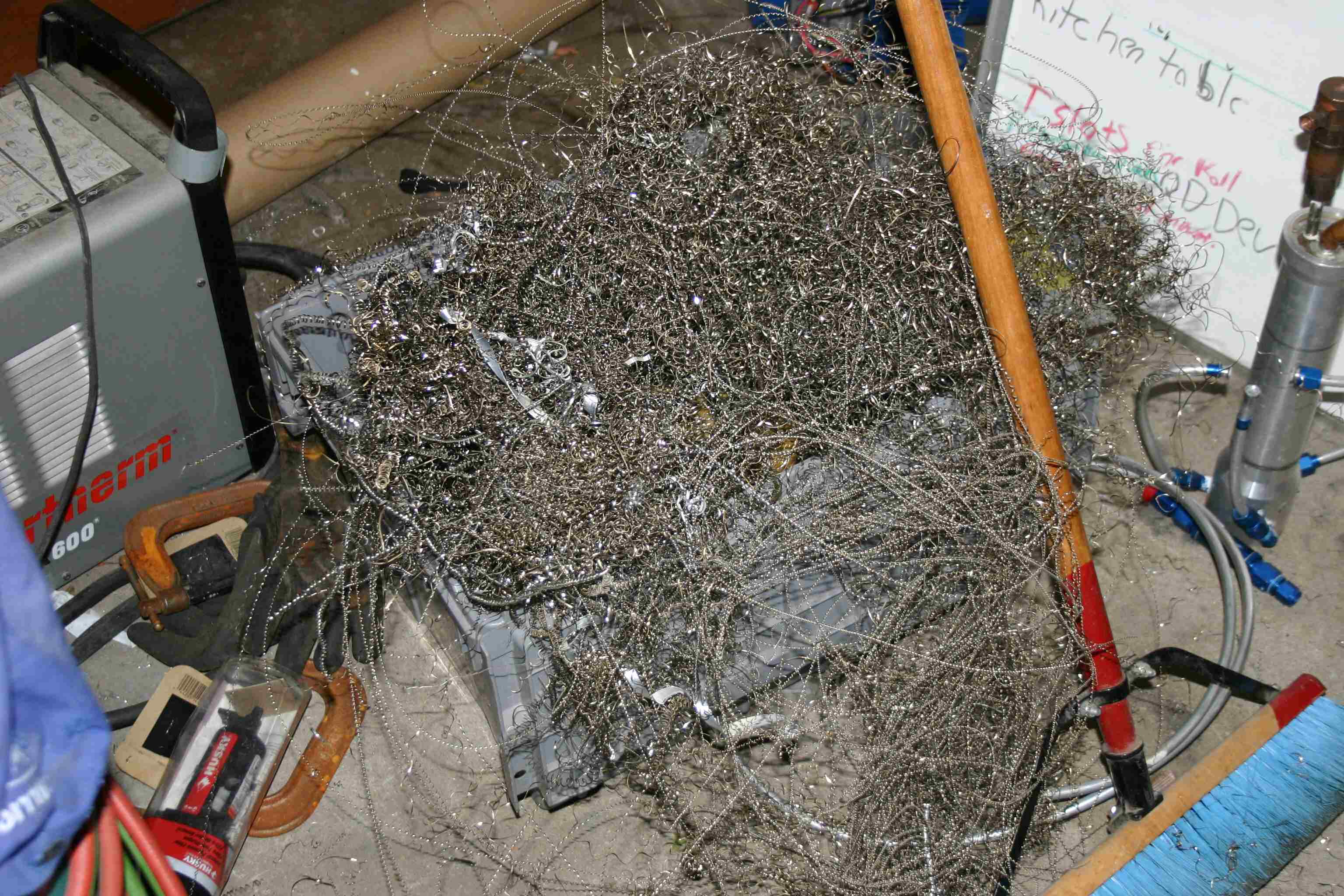
Lastly the lathe makes miles of razor sharp stainless turnings, They get tangled with everything and cut you if you just look at them crooked.Stainlessknives


 As a general rule I don’t wear gloves near machine tools, its a good way to loose your hand. So in the last 24 hours I’ve bled from 5 of my 10 fingers.


Cutfinger


The vanes are bieng used in a hot oxygen stream so I need the maximum oxidation resistance, otherwise I’d use 303 stainless a lot easier to machine. Did I say I hate Stainless?  Hopefully today will go better…


Friday, April 18, 2008

Plumbing complete

The vehicle plumbing is complete. I should have the Jet vanes finished Saturday. That leaves wiring. We weighed the vehicle as is and its  96 lbs . We have less than 5 more pounds to add (not including payload) and we should be a full 25% under our target weight. We can meet our 90 second hover with an average achieved ISP of 79 seconds.


Without payload running 90% peroxide we should be able to hover for 160 seconds.