Monday, January 26, 2009

Inside Outside...

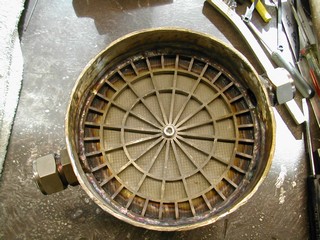
I know what the iinside of my chamber looks like, now to figure out the outside. I know what pressure drop I’m planning on at max flow in the jacket. So I need to figure out how many cooling channels and their width and depth. This is a bit of a black art so I drew up one pssible channel configuration and milled it as a slot in some aluminum. I then bolted a face plate against it. I put 18 PSI water pressure in one end and captured 10 seconds of flow that I weighed it was 390 gm. This was about 30 to 50% higher than I wanted. So I need to make them smaller, or reduce their number.  I also sent the cad model of my slot to my friends at flowmetrics and Carl was going to run a CFD check to see if experiment and simulation agree. The one big benifit to doing the simulation over the experiment is that it wont spray water on the front of your pants making the neighbors  think you had an accident. It will also allow one to do some proper heat flow analysis.


TestPlate


The test plate on the garage sink


Lathemount


The Lathe mount I worked on for several days. The boreing bar is 11” long to the face of the holder. This solid peice replaces the rotatable stock secondary slide. (Look up a birmingham or grizzly 13x40 lathe for a picture)


Lastly the motor insides I bored out of solid block of aluminum:


Regen_h2O2


All Day...

My new Lathe parts work well, I finished them this morning and then  I spent remainder of the day machining the inside of a motor out of a solid chink of aluminum. I am basically taking a 8” x 16” Solid aluminum round and removing everything that does not look like a rocket motor. I started at 9 am, its 1am a 18 hour day in the shop  on hard concrete. My feet hurt.

Friday, January 23, 2009

Just checking in

Since the ring catalyst failed we are evaluating two other kinds. We are looking at traditional silver plated nickel and some metal monollytic catalysts. We have some samples of the metal monolyths we received from John Carmack and we hope to test them in a regen cooled engine capable of running in Monoprop or Biprop mode in a week or two.  I ordered the nickel screens and hope to fabricate a motor for that configuration in the next two weeks.


I’ve been working on machining the regen engine out of a large chuck of aluminum and the size is stressing the capabilities of my lathe. The Lathe is a manual lathe converted to CNC and the cross slide tool mount was not very rigid. I started more than a week ago to machine some new mounts and the speed control on the Mill motor started acting up. So I bought the Tormach speed control upgrade (stock on the new Tormachs) and Its a great upgrade. Now that is fixed, I’ve spend the last week machining new tool mounts out of large chunks of steel. they should be more rigid.  The mill is machining the last piece as I write this so I hope to get back to machining the actual motor on Saturday.  Machining Aluminum and the C145 copper is fun, Machining stainless is miserable, machining medium steel is some where in the middle, not as picky about feed rate as stainless, but still wears the tooling a lot faster than aluminum. 


On a side note I stick all the tools I use at the mill, draw bar wrench, vice wrench, chuck keys etc… to the back of the mill with some strong magnets.  With aluminum or Stainless this is not an issue, when machining  steel all the sharp chips stick to the tools making it a hazard to use them. No fun at all.


Sunday, January 11, 2009

Test Results: Ring Catalyst Fails.

The Ring catalyst failed to get good decomposition. I have video of lots of billowing steam as the partially decomposed peroxide falls on the concrete in the flame trench. I probably won;t post these as they aren’t very interesting.


We were out at FAR at the same time as the FloMetrics guys and their LR-101 rocket static test went well. 10 Second burns on both RP-1 and Biodiesel. These videos I will probably post when I get time to do so. The sound of a kerosene rocket is just different that than lox-alcohol, hybrids, solids, sugars, and mono props. They all have a different sound and the kerosene sound is very cool.

Friday, January 09, 2009

Static Test

Our stuff is packed we hope to do a static test of the new solid cataylist on Saturday.


Friday, January 02, 2009

Designing a chamber....

So you want to design a chamber, there are many ways to do this. My method is not real rigorous, but here it is.


First know what you want. For this example:


  • 90% peroxide /kerosene with a solid catalyst.

  • 915 lbs max thrust. (This is 125% of max weight for my notional 180 sec vehicle.)

  • 320 psi feed pressure (This is our hydro pressure /1.25)

  • Optimize for best eff at 475lbs thrust. (This is the mid point on a 180 second burn this number probably needs adjusting upward as more fuel is burned at the beginning of the flight)

  • Operate at FAR or Las Cruces, or the new Mexico space port about 4000 ft altitude. (12.4 psi)

Given a 320 PSI feed pressure we need to allocate some pressure drops, I’ll use 75 lbs in the cat pack and 20 percent in the injector /diffuser.  I got the 75 PSI from a  FMC peroxide catalyst pack design document.  I got the 20% from word of mouth and vague references in Sutton.


So the resultant max chamber pressure is (320–75)*0.8 = 260 PSI.


So at our desired optimum 475 lbs we have a chamber pressure of


Cpopt=(475*260)/915 = 134 PSI.


Next Ill run this through cpropep. I ran lots of cpropep runs to arrive at the 0.17g of fuel for 100gm of 90% peroxide. This is the final input file run:


Propellant X/Y
+466     0.90 g
+976     0.10 g
+797     0.17 g


FR
+chamber_pressure     134 psi
+exit_pressure         12.46 psi


The output is:


Thermo data file: thermo.dat
Propellant data file: propellant.dat
Computing case 1
Frozen equilibrium performance evaluation


Propellant composition
Code  Name                                mol    Mass (g)  Composition
466   HYDROGEN PEROXIDE (100 PC)          0.0265 0.9000   2H  2O
976   WATER                               0.0056 0.1000   2H  1O
797   RP-1                                0.0121 0.1700   2H  1C
Density :  1.228 g/cm^3
3 different elements
H  O  C
Total mass:  1.170000 g
Enthalpy  : -6420.12 kJ/kg


114 possible gazeous species
3 possible condensed species


                       CHAMBER      THROAT        EXIT
Pressure (atm)   :       9.663       5.463       0.848
Temperature (K)  :    2418.562    2205.550    1608.636
H (kJ/kg)        :   -6420.118   -6948.077   -8362.579
U (kJ/kg)        :   -7389.021   -7831.644   -9007.016
G (kJ/kg)        :  -36931.242  -34771.963  -28656.161
S (kJ/(kg)(K)    :      12.615      12.615      12.615
M (g/mol)        :      20.755      20.755      20.755
(dLnV/dLnP)t     :    -1.00000    -1.00000    -1.00000
(dLnV/dLnT)p     :     1.00000     1.00000     1.00000
Cp (kJ/(kg)(K))  :     2.50147     2.45427     2.27083
Cv (kJ/(kg)(K))  :     2.10086     2.05366     1.87022
Cp/Cv            :     1.19069     1.19507     1.21421
Gamma            :     1.19069     1.19507     1.21421
Vson (m/s)       :  1066.56503  1027.58281   875.97064


Ae/At            :                 1.00000     2.44989
A/dotm (m/s/atm) :               157.40662   385.62851
C* (m/s)         :              1520.94574  1520.94574
Cf               :                 0.67562     1.29592
Ivac (m/s)       :              1887.43319  2297.97666
Isp (m/s)        :              1027.58281  1971.02048
Isp/g (s)        :               104.78429   200.98815


Molar fractions


CO                   9.0878e-002 9.0878e-002 9.0878e-002
CO2                  1.2411e-001 1.2411e-001 1.2411e-001
COOH                 3.2035e-007 3.2035e-007 3.2035e-007
H                    1.6249e-003 1.6249e-003 1.6249e-003
HCO                  2.3091e-007 2.3091e-007 2.3091e-007
HO2                  1.8081e-007 1.8081e-007 1.8081e-007
H2                   8.5414e-002 8.5414e-002 8.5414e-002
HCHO,formaldehy      3.0941e-008 3.0941e-008 3.0941e-008
HCOOH                2.3185e-007 2.3185e-007 2.3185e-007
H2O                  6.9535e-001 6.9535e-001 6.9535e-001
H2O2                 1.3262e-007 1.3262e-007 1.3262e-007
O                    3.1412e-005 3.1412e-005 3.1412e-005
OH                   2.4808e-003 2.4808e-003 2.4808e-003
O2                   1.0559e-004 1.0559e-004 1.0559e-004


Lots of data here but I really only want the four items I set in bold.


First dimension question how big is the throat?


For 915 lbs thrust at 260 PSI we need the Cf number.


So Throat Area = 915/(260*cf) =2.71 sq inches in area.


The Throat diameter is thus 1.859473 inches.


For thoose who want consistent SI units:


915 lbs is 4080 N  260psi is 179 N per cm^2


So At = 4080/(179*cf) = 17.58 cm^2


converting back to inches for a consistantcy check we have 2.72 sq in.


Now that we have the Area Throat we need Area Exit


Ae=(At*Ae/At) =2.71*2.44989 =6.65 sq in and a diameter of 2.9147 inches.


So now we have the Throat diameter and Exit diameter.


We need the chamber length. This chamber will have Gas/Liquid mixing so we can probably use a shorter chamber than usually, but I’m going to be somewhat pessimistic and use a L* of 50in. I’m also using some fixed catalysts at 7” so my chamber inner diameter is going to be 6.5”.


6.5” diameter is 33 sq in. The At =2.71 so 2.71*50/33 = 4.1 inches.


We now have the major dimensions of the chamber done.


  • Throat 1.859 in diameter

  • Exit 2.915 in diameter

  • Chamber 6.5 in diameter

  • Area before the throat 4.1 in long.

The Now to draw some shapes. One could use the classic 15 degree exit cone that would be easy to machine, but gives up a few percent performance. Or one could try and do a parabolic expansion cone. I used the RAO optimum nozzle approximation. This is covered in Rao’s classic paper or texts like Modern Engineering for design of Liquid propellant Rocket Engines (Huzel/Hwang) . This requires that you pick a couple angles off a graph and fit a parabola to the resultant points. The problem is actually over specified so you have to decide which end of the parabola you want to be exact. The cook book formula gives you 4 equations and 3 unknowns. For the more math inclined you have two specified points and the slope at both points and you want to fit a 2nd order parabola through these. Like I said over specified. (You can see the document in question by doing a google book search look at page 76. Search for Huzel Hwang) So after getting some advice and a code snip-it from arocket I wrote a short program that fits a parabola to the defined points . I assumed a 100% of conical length.


So I drew the chamber in the following steps….


  • Placed a reference  point at 0,0 and one at 0,(1.859/2) (black)

  • Drew an Arc of 1.5 rT to 60 degrees (red)

  • From the chart Fig 4–16 initial angle is ~20 degrees. So I drew an arc blue of 0.382 Rt to 20 degrees.

  • Then I placed a point at the exit position. A 15 degree half angle cone would be 1.97 inches long going from 1.859 to 2.915 inches. So I plot this point referenced from the throat. (Green line)

The result at this point:


ChamberStep1


Now using my CAD program I read the x,y locations for the end of the blue arc:


Point at (0.239756,0.971775,0). And the end of the green line. Point at (1.97,1.4575,0).


I plug all this into my little program and calculate a script to draw the nozzle. The Program :File Attachment: calcv2.cpp (1 KB). Now I have the basic chamber contour. All I need to do is Add the upper chamber and mirror


LP180CpOutline


Next steps involve giving the chamber some thickness and the design of the catalyst holders and injector/diffuser seals connections etc…. to be continued….


Friday, December 26, 2008

Merry Christmas

I won’t be blogging much until early next year. There is a possibility we may static test our new motor sometime between 31st and 4th. I’m looking forward to more progress in 2009.  The gear box is 90% done I need to make one more bearing plate, but all the major structure is done. All the rotating parts are done. It’s heavier that I would have liked. When I’m done I will fully disassemble and weigh the individual parts.


Gearbox2GearBox3


Sunday, December 21, 2008

Why I like this project....

There is very little I enjoy more than learning something new. A traditional aerospace project is an effort involving thousands of specialties. This offers the opportunity to learn thousands of specialties. I have received my Peroxide compatible pump, fuel pump, and motor. I’m in the process of assembling a gear box. I’ve never built a gear box before so one gets to learn new terms like pressure angle and involute. As well as use new tools.. I’m continuously impressed with the variety of free tools available on the web. I’d gathered all the shafts, bearings, gears, parts and etc in to a big pile on my desk. I spent the better part of yesterday laying out the gear box.


I have a fully 3d capable cad system, but I usually do my layouts as 2D line drawings. I find this easier than making a 3D model. My gear box sketch is below as I have been using it (Labels added for your viewing pleasure)


Gearboxv2


File Attachment: GearsV2.pdf (24 KB)


I’ve machined the top base plate, the adaptor that joins the peroxide pump to the base plate and the curved offset spacers. (Only shown in top view the semi circular arcs with screw holes ).  Today I’m going to try and build the complicated shaft that connects the two pumps to each other and to the gear drive. I’m also going to finish bore the gears and lighten them. If all goes really well I may even get to a full trial assembly.


Gearboz


This shows the peroxide pump and the aluminum adaptor connecting it to the main plate. It also shows the curved spacers.


Monday Morning update. I machined the shaft and couplers for the pump side , I also lightened he commercial gears and bored the one that needed bored.


Friday, December 12, 2008

Back to Hardware....

We are   were going to go out to the test site and static test the blue ball with a “solid” catalyst. (The FAR event was canceled due to 75mph winds forecast on Saturday as I was typing this.)


John Carmack sent me several catalyst styles, one kind was a pourable ring catalyst from cpilink.com It looks like the picture on the right here. So we had some stainless plates  water jet cut by Thunderbird Water Jet to hold the catalyst rings, and we added a sintered stainless diffuser plate. and reassembled the motor.


Stainless motor 003


When we first cut the motor apart the inside was kind of nasty with permangenate residue.


Catalyst motor 001


A picture of the sintered diffuser plate welded to the support ring.


Catalyst motor 003


A view from the other side as it is welded into the top of the motor.


Catalyst motor 007


A view of the waterjet cut bottom support plate. The area between the two plates is filled with the ring catalyst. The fittings on the side as shown on the view of the motor top allow us to shake the catalyst out and replace it.


Catalyst motor 009


The reassembled motor ready for testing…. soon.

Wednesday, December 03, 2008

New FAA rules.

The new FAA amateur rules were released today. It looks like they will be officially published on the 4th and become effective on Feb 2nd.  Since this removes the burn time limit and requires nothing more than ATC notification for flights in  uncontrolled airspace more than 5 miles from an airport, it basically means ZERO paperwork for the testing and development of a hovering LLC class vehicle that stays under 200K lb/secs of total impulse.  I’m practically giddy!

Monday, November 24, 2008

Thanksgiving week...

While we all enjoy the company of friends and family during this thanksgiving holiday, don’t forget the men and women of our armed forces that may not get the chance to be home this holiday season. I’ve given something to LBEH for the last 7 years to try and help. Some bloggers have a tip jar, I ask that you send any tips there instead.


Offical comments on 2009 LLC


See http://thelaunchpad.xprize.org/2008/11/2009-lunar-lander-challenge.html

Friday, November 21, 2008

A Quick update...

My next rocket project is to finish up some test stand work for a paying customer I can’t talk about.


As for the LLC projects :


I’ve been exploring a number of catalyst options for peroxide. I’m looking at silver plated nickel screens, and commercial catalysts from several different vendors. These include the commercial catalysts from CPILINK that John Carmack was kind enough to send me. If that catalyst is still commercially available then its high on my list. All of the parts and pieces to build an electrically pumped biprop peroxide test have been ordered. I have all the parts on hand to both convert the 90 Second vehicle to a solid catalyst and to build a biprop version of very similar design capable of doing 180 seconds.


The plans for next years LLC have stirred a bit of controversy and I’m not sure what side of the debate I agree with. The basic problem is this: The LLC is supposed to be an impartial contest, yet you have the head of the Xprize, Peter on video telling John Carmack that they will expedite the 2009 contest so Armadillo does not have to wait a full year to win the prize. That was an astonishingly ill conceived video. Peter has a personal business relationship with Armadillo, so even if there are a million legitimate reasons to accelerate the contest and change its format, that one video could be used by anyone with an axe to grind to trash both the concept of government prizes and the xprize organization in particular.


I’d really like to see the 2009 LLC be a first to demonstrate at any location like the original Xprize. This would simplify the contest for all competitors as you would only have to get permission to fly in one location, not both your testing base and the LLC venue. It would also reduce the financial burden on the xprize organization as the local logistics would be resolved by the team and not Xprize. From a personal stand point It would improve our odds of winning the 2nd place 90 second prize and enable us to then switch our focus to taking a shot at the 180 2nd place prize when we were ready rather than at some specific date. . Unfortunately I’ve personally received enough private E-mail from multiple people just steaming mad about this that I can’t see the possibility of any change in the LLC format without it ending up in court.


The sad part about this is that after spending two years working on this I have a feel for the difficulty level and I don’t see that any of the new not yet flown teams have a shot at getting a 180 second vehicle ready by October, its just too hard. Other than armadillo we are the only currently registered team that has fired a motor to thermal equilibrium with the necessary performance to do 180 seconds (Our Lox Ethanol motor) and we have chosen to take a different direction.

Monday, November 10, 2008

Plans...

90 Second Vehicle.


John Carmack was really kind and sent me some peroxide catalyst material Armadillo was no longer using. I’m going to rebuild the present motor with these cataylsts. I’ll try to provide some pictures. I’ve ordered some stainless parts and some sintered stainless screen to spread the peroxide out. I figure about 4 days of work and this will be ready.


Things to fabricate /do:


  • Fabricate New Motor upper section.

  • Revise my safety plan with no liquid catalyst and get the waiver extended/approved for this configuration.


180 Second Vehicle. #1


We have a pressure fed 180 second airframe 95% fabricated.  It will be a Peroxide RP1 biprop. To finish this vehicle we need to design a chamber and  switch to thrust vector controls. If we get the same percentage of theroretical perfomance as we got with our monoprop vehicle this will hover for about 195 secondds in blow down mode. If we put active presurization on the vehicle it will hover for 240 seconds. My friend Steve Harrington of Flometrics is dying to try out a liquid nitrogen presurization system modeled after the liquid helium system on the origional apollo lunar lander system.  So if we don’t quite get there from a performance stand point with blow down we will add this Ln2 system.


Things to acquire fabricate/do for this vehicle:


  • Fabricate a regen chamber. Currecnlty working on an aluminum design, have stainless and nickel designs sketched out, but will try aluminum first.

  • Fabricate TVC controls, both Masten and Armadillo are using Bug actuators, a bit pricey, but I’ll probably go that way.

  • Fabricate  valves usign the existing valve design(s) we have.

  • Start the paperwork process so we can do tethered flights in Jan/Feb time frame.


180/300 Second vehicle concept development work:


I’ve done a lot more modeling of a 4 engine electrically pumped vehicle. I really like the results I’m seeing. Even more I like the fact that the propulsion is almost 100% decoupled from the tank design.We are going to go ahead and purchase one set of parts to build 1/4 of the propulsion system. I’ve found a vendor for a positive displacment peroxide compatible pump that is the right size for a 4 engine pumped vehicle.I’ve alos found a vendor for the the motor and speed control of the approriate size.  If this works the parts could be easily transfered from a hovering  LLC vehicle to a 100Km+ capable reusable suborbital sounding rocket. If the all the LLC $$ had  been won this would be my primary project.  If this sounds interesting to anyone my priorities can be altered with the proper application of funds ;-)


Things to change in the flight test program:


The Rough terain forklift worked really well so it is going to return for an encore performance. Since construction is slow in california the rental prices have really fallen. One problem with the testing I did for the 90 second vehicle was the cost of each full fuel test. I’m going to modify the vehicle(s) to carry lead bricks to simulate a full fuel load. This way I can verify I have the necessary propulsicve performance without burning up 2K of peroxide for each test. I can put in a single Jug of peroxide and time the hover with the weight and know if I have the proper performance.


Monday, November 03, 2008

Lessons Unlearned

In 2007 we tried to build a 4 engine Lox Ethanoal rocket. When we were done it had 39 valves and was just wayyyy too complicated to work reliably. My present 180 second fantasy goes back in that direction a tiny little bit. If youmake the following assumptions:


  • Electrically driven peroxide and RP-1 pumps.

  • Catalyst decomposition with lots of pressure drop for relability

  • 1000 to 1200 PSI feed pressure

  • 700–800 PSI chamber presure.

  • Four engines.

  • 80% of theoretical ISP.

Then what drops out is


  • Off the shelf small aluminum frame hydralic pumps (Possibly with one section redone with stainless gears)

  • Off the shelf  Pump motors,batteries and gearing from  high end 600 sized RC helicopters.

  • Hover times of 240 seconds+ with payload.

  • A rocket with two manually operated valves (Vent and drain)

  • Tanks with a pressure safety factor >4 so humans can be near the presurized rocket.

  • A rocket with no active valves. (All control is from the pump speed control)

  • Precise Mixture control.

  • Safety system is all electrical, power stops to motors and down it comes.

I’ve ordered a pump to evaluate its peroxide compatibility and life time running unlubricated.  The pump was only $72.

Thursday, October 30, 2008

Level 2 is hard

A lot of people have advised me to ignore the 180 until the 90 is in the bag. Its probably good advice, but I’d like to start doing some 180 second development tests when we go out to the site to test the 90 second vehicle. The trip to the test site is a significant portion of the time involved with a test and so I’d like to use that time for testing both if possible.  I did a very detailed model last night. I started with the following assumptions:


  • It needs to stay as an amateur vehicle IE total impulse < 200K lb/sec

  • I’ll use an off the shelf LR-101 as the motor

  • I’ll use the same AMS industries Spun 5086 aluminum hemispheres for tankage that we used for the 90 second vehicle.

  • I’ll assume that the LR-101 ISP starts at 200 at design Cp and degrades along the same slope as Cpropep down to the minimum Cp (Cpropep says LR-101 should give 230 Isp at design pressure) This discrepancy is probably because the LR101 is significantly over-expanded at sea level.

I included in the model:


  • Pressure Drops in the LR-101 Jackets, and Injectors

  • Isentropic Gas expansion in blow down mode.

Given these assumptions I could not build a 180 second vehicle. so I modified the assumptions:


  • Add one Carbon fiber SCI 602 presurization bottle and Regulator to use on the LOX side. Allowing us to  fill the Lox sphere  past the point where blow down mode would run out of pressure.

Given these assumptions the model says we can hover for 200 seconds.


This probably won’t work for the following reasons:


  • The motor is WAAAY over-expanded for the entire flight. We could use all the LR101 dimensions and injector and build a motor that has the same internal dimensions and lower expansion ratio. this would likely give us back some ISP, but we are no longer off the shelf.

  • The motor needs to throttle 4:1 and as the pressure drop in the injectors goes down that low then we probably don’t get good mixing.

  • The outcome is really sensitive to the initial loading conditions over/under filling the Lox tank by 5% causes a 10 second change in the hover period.

  • We need to get the same hydro test performance out the tanks as Armadillo is getting and our first tank was 25% low, we have not yet been brave enough to test the 2nd tank to the level we need.

  • It would be really hard to keep the mixture ratio matched exactly over a 4:1 throttling ratio without really good closed loop controls.

  • The LR 101 is hard to get lit.See the SDSU rocket at 1:42 into http://www.youtube.com/watch?v=Wzl_IaSJx28 

Some additional thoughts on the 180 second problem:


If I use different sphere sizes and thicknesses and put on lots of pressurant bottles I can get my detailed model to say we hover for 230 seconds, but the same issues identified above apply.


The 180 second level 2 is all about getting good mass ratio and ISP. For non-pumped systems the density of the propellants really matters. I’m using 1.1 as my Lox density 0.8 as my RP-1 density. I really think Peroxide would be better, 90% peroxide has a higher density than Lox 1.36, and it also makes up a higher percentage of the total propellant load so the portion of your propellant at 0.8 is lower. I’ve seen Density * Isp ^2 as a figure of merit (FOM) in SSTO studies.


Examples :


  • Peroxide RP1 at 200 PSI running at best ISP has ISP 215.6 and Density 1.246 FOM: 58K

  • Lox RP1 running at LR-101 mixture ratios and 200 PSI has ISP 219 and Density 0.993 FOM: 48K

  • Lox RP1 running at best ISP and 200 psi  has ISP 230 and density 1 FOM: 53K

You are much more likely to get the peroxide motor running at peak ISP to cool in regen mode as there is much more cooling fluid available with a much higher heat capacity. Its clear the LR-101 designers with an infinite budget did not choose to give up 10 points of ISP with out trying.


One LLC competitor that had a static display at the 2006 xprize cup, had a system with electrically driven positive displacement pumps using peroxide, liquid catalyst and a fuel. this insures constant mixture ratios across the entire throttling range and makes your FAA safety system really easy as you just have a power relay that drops power to the pump and all propellant flow stops. Your tank thicknesses  are set by minimum gage issues not pressure requirements.  If one developed this it would also be easily transfered to vehicles with more aerodynamic tankage than the big spheres. (Space here we come….)

Monday, October 27, 2008

You know rockets have taken over your life when...


You know that rockets have taken over your life wihen the Google street view of your house has the truck parked in front with a rocket test stand and an empty LOX dewar in it. We never parked there with a full dewar. The combination of things in the truck puts the picture between May and Sep of 2007 The real estate sign is not for our house.

Sunday, October 26, 2008

Performance Dreams and Spread sheets....

According to Propep 85% peroxide has the following “frozen” ISPs at our altitude.


  • 250 PSI :125

  • 162.5 PSI 118

  • 75 PSI : 103

Our realized ISP was about 83.


If we had gotten 90% of the lowest number: or 92.7 we would have hovered for 99 Seconds.


Checking Cpropep  against the FMC peroxide manual we get 130.32 (propep) compared to their 129.0 comparing like to like. (250 PSI 90%, 1ATM Pe)


So one possibility is that we switch to a solid catalyst. This sheds some weight, but lowers chamber pressure for the same tank pressure…. crunchingg the ISPs second by second as the chamber pressure goes from 220 down to 72  assuming 80% of theoretical performance we get 100 seconds. Assuming 100% we get  124


If we bump from 85% to 90% HTP and switch from N2 to He for our presurant (Our back up reserve boosters) still assuming 80% of theoretical we get 109 seconds.


One of the problems is that if you set the expansion ration so you are good at your lowest presure you are kind of stuck with that ISP for the whole flight. So you plan on running underexpanded for 50% or so of the flight. I’ve not found a good way to model performance underexpanded.


Friday, October 24, 2008

Condolences to True Zero and Congratulations to Armadillo.

Condolences to True Zero and Congratulations to Armadillo.

I have mixed feelings about TrueZero, I know the agony they are feeling, yet I'm a little bit personally relieved that I made the right choice to not compete this year.

Armadillo's third years the charm! Armadillo did 1/2 the task at the contest at least 5 times (I've lost count) before winning, they really deserved the win.
Now on to Level 2.....

Monday, October 20, 2008

2nd thoughts about a rational choice.

From a development standpoint we are at about the same technical level as True Zero, they decided to go to the contest we did not. Seeing them go has caused a lot introspection on my part for the last few days. Emotionally the decision was hard, rationally it was and is the right decision. 


First off we promised both the FAA and the Xprize foundation that we would demonstrate both a 90 second hover and a free flight. The 90 second hover  requirement was in our FAA application and in the LLC rules.  We could not accomplish that before the go/stay decision needed to be made. While I could have asked to waive the requirements, personally I don’t like waiving safety based rules. As a general principal establish your safety rules before you go out to the field and don’t violate them with out a pow-wow of all involved to think about what you are violating. I can’t say were 100% perfect on this front, but we try.


Secondly I saw no reason to risk the vehicle. When I was my sons age my Dad and I designed built and raced outboard hydro planes. We were successful with what we did. We placed at the nationals with our first joint boat design.  This taught me one thing  things never go as well at the competition as they do in practice. If you have an issue every tenth practice it will appear in every competition, thats just the way it happens.  We aren’t afraid to loose the vehicle, we just don’t think it makes sense to risk it until we have worked out more of the bugs. We have complete spare airframe all fabricated, it passed hydro last week.  I have a spare of every single part on the vehicle with two exceptions: I have not welded up the spare motor because we need to work on the mixing problems. I haven’t built a new vane assembly because I want to upgrade that to Rene 41 for possible biprop use. 


Third in order to go to the competition I would have had to write a 22K check for insurance. I would say without getting it done in practice we would have a 10% chance of success. All this for the possibility of taking 2nd place. I have no illusions after watching the Armadillo team center on the pad with their camera  in real time, we could not beat that for the tie breaker.


If Armadillo takes the two first prizes that leaves 2 second prizes to be won. True Zero could take it, but given my own estimation the odds of that are low.


If the first prizes are won then its possible that the rules will change to first to demonstrate rather than a central exhibition.  This would allow me to demonstrate at my “home field” under my waiver without having to buy insurance. This could happen as soon as midyear. So I wait 6 or 7 months, get to do a lot more practicing, save 22K and improve my chances.  


A rational decision…. emotionally its still hard to stay home and watch others toss Hail Mary's.

Saturday, October 18, 2008

We came so very close...

I just reviewed the data from our successful and unsuccessful flights.


By backing the realized thrust coefficient out of the successful flights and the chamber pressure from the unsuccessful heavy flight we are within  6%. If we had 6% more  Tank Pressure or throat area we would be flying.   Argggggg!  This would mean Hydro+ing the tank to ~ 400 PSI. I’m almost tempted to go out in the garage and pump it up to that point.


Our realized ISP was only 65% of theoretical(Adjusted second by second for chamber pressure ISP changes) If we could fix the catalyst mixing or had chosen a solid cat instead of the hated purple menace we would be golden! If we could hit 75% of theoretical ISP we could reduce the fuel load enough to do it.


If wishes were horses beggars would ride.


Best luck to Armadillo and TrueZero

Thursday, October 16, 2008

Were Done for the Year.

Keven met us at FAR and we tried a 90 second hover. We just did not have enough thrust to lift the vehicle with the fuel necessary for a 90 second flight. We had margin in the system design, but not enough.


We never did get the mixing to work well enough to get proper decomposition. This lowered ISP meant more fuel to carry, higher liftoff pressures and higher flow rates on the flow orfices, we had some margin in each area, but the low ISP and poor mixing ovewelmed the margin. We can fly for 60 seconds, maybe even 75, but not 90 seconds with 25Kg of payload. We will try again in 2009 if there are prizes remaining.


 I assume that at least the 180 second the 2nd place prize will be unwon.


I’m going to take some time off and relax, I want to thank all the people that have wished us well and folowed our journey. I also want to wish the Armadillo and truezero teams good luck.

Tuesday, October 14, 2008

Poor Mans Metrology

Many months ago we hydro tested our Sphere (370lbs) , Yesterday we tested our Backup vehicle sphere (385lbs) ,today I tested our new catalyst tank (475lbs) . These pressure tests set the upper limit (with some safety factor ) of what pressure we can operate the tanks at. In a traditional aerospace company everything involved would be “calibrated” and traceable to NIST. We can’t afford that so we do the next best thing we calibrate the pressure transducers used on the vehicle against the beat up old pressure gage on our hydro tester.


So I pumped up the transducers while hooked up to the vehicle electronics and compared what the telemetry said against what the gage said. I’m happy to report that they match exactly.  


The new Cat tank is installed, the repositioned catalyst injectors on the motor are done and the valves and vehicle all check out. My son is on the way back with a Swageloc fitting we needed to hook up the last new line to the new cat tank.  We are still on track to leave tonight and we will try a short translational flight under tether and then a long 90 second hover under tether at daybreak Wednesday morning.

Still trying......

We will keep you posted on any new tests. Today we receive our new 316 Stainless Cat tank. If all goes well and we can arrange for an early morning meeting with Kevin we may try a long hover Wedensday.

Saturday, October 11, 2008

Status uncertain....

We flew a 59.5 second tethered hover with payload today. For the amount of fuel loaded we needed to get to 65 seconds. We thought we ran out of peroxide, but on more examination we ran out of catalyst, and the last few seconds of flight were in water rocket mode with the remaining peroxide.


We ran out of catalyst because our catalyst tank sprang a pinhole leak in one of the welds. That ended todays testing. This looks like it might end our year as well. We drove home to try and adapt one of our 14” spherical tanks to replace our leaking 10” tank and it just wont fit.  In driving home we had a long discussion, I’m for calling it done for this year and trying to pick up the 2nd place prizes next year. My Son does not want it to drag on beyond this month, so he wants to make a hail mary attempt for this year.


I don’t know if it is even possible. To make it this year we would have to:


Fix the tank problem and go out and test with Kevin for a 90 second tethered flight on Wedensday. Then go do the free flight next Sunday, 5 days before the contest. Can we still satisfy the Xprize and the FAA with less than 5 days between the possible required test and the contest?


We just don’t know. We will keep you posted.


True Zero is close, but they are just about to discover that their performance is not quite what they expect…. (see the comment at the end of their last post) We are struggling with that. It looks like it may be an Armadillo only show this year again,  we gave it all we had and it looks like we might come up just short….


Friday, October 10, 2008

Update...

Wedensday was scrubbed by problems with our remote quick disconnects, So we spent Thursday redoing them from scratch… Much Much better. We were going to leave Thursday night, but th wind Gods in moajve did not think we should fly…. gusting winds, wind warning and blowing sand yuck.


So I spent the morning going over the vehicle with a eye for potential problems. I found an issue with the vane actuator wireing harness that was not quite right and fixed that. We’ll do some flights on Saturday, but FAR is going to have a lot of people out for various projects nearby so we may not get to fly saturday at all. My waiver requires that I clear the uninvolved from the area for flights over 14.999 seconds.


All in all were ready to go out testing  4 hours before we are due to depart! I’ll keep everyone posted when we return.


Tuesday, October 07, 2008

Two weeks from Today...

We need to leave for the XPC two weeks from Today.
We are going to try and test very early Wednesday morning (If Kevin can make it).
(Scrubbed, our repaired quick disconnect broke. Parts arrive Wednesday.
we will try for Friday morning.)

We are also going to try and test either Saturday or Sunday.
(Depends on people and Scheduling at FAR and the ability to clear the area of the uninvolved.)

If we have not completed the 90 second tether and the free flight by Monday we are realistically done for the year. Its been a real push to get everything done and the lack of sleep is starting to wear on me. I'm at the point where the push to complete is taking a toll across a broad spectrum of life, physical, emotional, relationships, work are all strained.

I've been pushing for 18 months so I can push for 16 more days, but I'm looking forward to Oct 26th one way or the other.

Friday, October 03, 2008

Status...


  • We built tested and installed a new emergency vent valve to replace the one that got snapped off.

  • We finished rewireing the top end of the vehicle.

  • We repaired the bent vane mount.

  • We modified the motor so we can change catalyst orifice sizes.

We are waiting on several next day parts orders but the tasks for today are:


  • Reassemble and calibrate the vane actuators.

  • Change the position feedback on the main valve to be more robust and visually verifiable.

  • Redo the bottom end wireing

  • Buy more Tether (clmbbing rope)

  • Replace a damaged battery

  • Replace all the battery tie down straps as they were damaged by the peroxide.

  • Replace the 1” Peroxide check valve with a 1.5” checkvalve.  (One of the parts we are wating for)


Thursday, October 02, 2008

Going for it...

We are going to keep trying for at least another week. I’ve confirmed that the main valve had sensor clocking issues.


Notes and Video


(This post won’t make sense witout the previous one) After reviewing the data I think we have two problems. We have some kind of issue with te Motor and consistant throttlings. It may be as simple as having the magnetic sensor that monitors the throttle valve position be wrong/loose.


The second problem is a heavy weights it vibrates a lot more this is causing problems measuring the GPS velocity, feeding back into the target pitch/roll to hold position loop causing the osscilation you see at increasing amplitudes on the video.


No decision on plans for this year. I need to look carefully at the damage.


Here is the video of the fateful flight. (I found it very difficult to watch) I’m still not sure how a vent on top of the vehicle can spray peroxide everywhere when the tank is less than 1/2 full.


Good news we got data right up the the end of the flight, the remote commanded shutdown of the vehicle works, the tethers and vehicle structure worked as designed , and the peroxide cleaned most of the spilled purple menace off of the pad. (It also damaged the tether ropes enough that they need to be replaced)

Wednesday, October 01, 2008

Murphy is a skilled and devious opponent

We tried a 90 second Tethered hover today. It did not go well. The vehicle would intially lift off then thrust would decay and it did not have enough lift. This may be a catalyst issue. At the same time we had dynamic stability issues at the heavy weight. We tried 5 times and on the 6th flight we solved the stability issue and murphy struck.  The vehicle lifted off flew stably and  climbed too high. When we hit the abort it got tangled in the tether and with close to 600lbs of weight it crushed all four actuators on the control vanes then fliped over tearing off the emergency event, showirng everything on the rocket with peroxide. The peroxide melted or damaged almost all of the wireing on the vehicle. All in all its probably a “60 hours of work event.”


We need to depart for the contest in about 21 days. We would have to have zero additional “big events” to have a chance. Its been an emotionally trying day. I’ve been up for 18 hours and I’m going to make a probaly futile effort to get some sleep. I need to make a difficult decison in the next 24 hours.

Monday, September 29, 2008

LLC Schedule

The LLC teams had a conference call Sunday at 11am PST to discuss the 2008 schedule. I asked if I could blog about it and was told that I should wait until close of business Monday.


Its Monday and I have not heard otherwise so here is what I know:


The Xprize team is trying very hard to keep the original October 24/25 date. They are currently planning to hold the event at the Las Cruces airport, the same location as the 2006 event. This involves a change in the pad distances and a whole bunch of new coordination. It will be a real rush to get this done in the next 25 days.


When the event was originally delayed I’d been a tad relieved, now that it is back on for the same date I have a boat load of work to do. I could not sleep last night so I got up at 2:30 and started writing. I wrote up a bunch of items to e-mail my FAA contacts and had several follow up phone conversations with them today. They noted with some amusement and possibly concern that my E-mails to them were at 8:30 PM on the 28th and 4:04 am on the 29th.


I’ve just finished revising my experimental permit application to reflect:


  • The Change in Venue

  • The Change in pad distances (50 to 100M)

  • The changes in the vehicle (Switch from leg tanks to sphere tank etc..)

  • Changes in operational procedures that have matured with the recent testing.

  • Changes in the order of things accomplished in flight tests.

  • Documentation of verification items completed.

I will publish the revised document when the project is complete this year. (I will also publish all the software schematics, and what detailed design notes I have at the same time.)


Now that the vehicle is flying my son is in the process of taking all the spare parts and building a duplicate. As the Armadilo guys told me don’t get too attached to your vehicle you will eventually loose one. Its a hard thing to face and with the upcomming free to altitude (55m) untethered flight comming up its a bit scary.  However we did not build a mueum peice, we built a flight vehicle and when  it is eventually lost thats part of the game. See the last flying vehicle I designed from scratch:Solar Splinter I’d still be working on that project if the FloMetrics guys had not gotten me hooked on rockets. Thanks Steve and Carl! I still have my rare stash of 20% efficent bare back contact solar cells and will some day do that one again.

Sunday, September 28, 2008

Slow motion video

Ben Brockert one the the Masten guys came out to watch.The following is a comment Ben sent to Arocket:


With permission from the Pauls I also took it as an opportunity to

test some of the MSS ground support equipment that I'm responsible

for, in this case the high speed camera.


Flight 4, first from ground, 1/10th speed:


Flight 5, off-nominal engine burn (steam?), 1/10th speed:


The Right Stuff: http://www.youtube.com/watch?v=Y-h1S9CUORU


We have 3 HD cameras and high speed capabilities to 1200 frames per second. If anyone wants to test an engine or system in Mojave, we're happy to consult and document.


Congratulations SpaceX!

I watched the launch, and  it looked perfect.


Way to Go!


Video

From the ground

Saturday, September 27, 2008

From the ground

We flew 7 times today, the primary changes were the addition of 25Kg of payload and some tuning of the vertical loop constants , both turned out perfect.


Flights 1,2,3  Perfect take off from the stands hover for 5 seconds at 1.5M then land.


Flight 4 Perfect Still attached to tether, but sitting on the ground Take off hover for 5 seconds land on the ground.


Flight 5 attempt on take off from the ground only got the ctalyst valve partially opened. We arn’t sure why,  we should  know more when we review the data. It took off, but could not maintain altitude and settled back on the ground in water rocket mode.  No damage. We reset the valve controller and …


Flight 6 the  third flight  from the ground to hover and back to ground was perfect.


The last flight was a very short flight to from the stands to burn off the remaining peroxide from the last flight. It lasted maybe 4 seconds. Again perfect no damage.


Some of the Masten folks came out to watch and Ben got some really cool slow motion footage of the flights. (Look for him to post it soon)  I’ll review data and post a video or two on Sunday. Right now its been a long hot day , I’m grumpy, sunburned and  don’t feel like editig video. ;-)


We have finally reached the point many rocketry people have dreamed about: Fuel is a significat cost. Our next flight series will include a 90 second hover with payload and the peroxide cost for that flight will be noticiable.


After that we need to do a free flight to 50 meters translate out, translate back and we will have completed the testing series required for our experimental permit.

Thursday, September 25, 2008

It gets easier

I’m preparing to go out and test again this weekend. Were planning to test Saturday Morning, were goin out Friday Afternoon. There is a FAR workparty trying to put up some shade and we vouelteered to pick up the steel roofing. We need to pick it up around 3:00 PM Friday in Ontario, CA. This means we leave around noon.


I’m spending this evening getting ready. Its the easiest prep I’ve ever done. The only hardware change is to add 25Kg of Payload to the vehicle in the form on srap on Ankle weights on the tops of the landing gear.  Earlier my Son and I  I flushed the Permangenate system and did a full operational check of the vehicle.


Other than that I’m charging all the batteries


  • 2 main flight batteries

  • 2 Main flight battery spares.

  • 2 IIP Abort batteries

  • 1 Emergency Vent Rx battery

  • 1 Emergency Vent TX battery

  • 1 Controller TX battery

  • Primary Lap top

  • Spare Laptop Battery

  • Spare Lap top

  • 2 Video Cameras

  • 2 Extra Vido Camera Batteries.

16 Total.


The only other physcial preperation is to copy some new anaylisys software to the Laptops and make sure the backup laptop gets updated with all the new software thats on the primary. It looks like the toal prep time will be less than 4 hours! WOOO HA!


If I’m going to fly under my flight waiver (longer than 15 seconds) I need to “clear” the uninvolved from the area. Since I’m going to be working on takeoff and landings this weekend the flights are all going to be under 15 seconds, under amateur rules. This is probably one of the better opertunities to come see the vehicle.


We test out near Cantil CA. If you want to send me an E-mail (you’ll have to answer my spam filter) with contact info I’ll give you a call Friday to discuss how to get there. I’ll be packing up by 11am so later than that and I won’t get back to you. My email is Paul at Romeo Alpha Sierra Delta Oscar Charlie dot Charlie Oscar Mike.

Monday, September 22, 2008

Thanks

When I started this project I wanted to show that significant things could be accomplished by a very small team. With our recent successful flights we have in some ways reached that first goal. We are going to keep striving to compete at the NGLLC, but it also seems like a fitting time to acknowledge some success and explicitly  thank some people:


My son Paul. It has been a privilege to spend the last 18 months working so closely with my son. He has done most of the non-electronic physical fabrication. He has also been invaluable is a huge number of logistics issues like making sure we have a crane, propellant, catalyst etc…. The project would not be remotely possible without him. When I was his age I spent two years working on a race boat project with my Father, I know it is not always easy.


My Wife Mariellen.  My Wife has been 100% supportive of me and my insane project. She has helped me keep an even keel during the inevitable ups and downs. She has been completly selfless as my Son and I have been absorbed by the project. Without her assistance none of  our progress  to date would be possible.


Charles Pooley of Microlaunchers. Charles has spent many many long days and nights at the FAR site providing us a helping hand. He has offered countless small suggestions. he is an invaluable resource into the history and methods of rocketry at all levels. He has always been available to help and has been an invaluable member of the team.


Beyond these three there are dozens and dozens who have helped, in no particular order, Steve and Carl of Flometrics, Bob our welder, Tom and the rest of my coworkers at Netburner, Kevin, Mark and Ted of FAR, John Newman,  John Carmack and the whole Armadillo team, David Weinshenker ,Mike Carden of XL space systems, Mike Kelly, Wynn  and Nick on my FAA team, and many many more.

Bonus videos

Fairly good attempt at a 5 Second flight with a Landing….


Diizzy footage from on board during the “Plus” flight.  I cut the start a bit too tight and missed takeoff…


Sunday, September 21, 2008

Code Test....

Given the following snippit of C code we are attempting to add damping or differential correction to the pitch stability. The values gain and DiffPitchRoll are constant doubles used to adjust the various gains.  This chunk of code runs 75 times a second and er.Pitch is the IMU raw pitch output. Given we want rate damping what should the sign of the differential correction be ?


/*****************Code Snippit *******************/


 static double pitch_prev;  
 double cur_pitch=PitchConvert(er.Pitch);
 double pitch_err=Target_Pitch-cur_pitch; 
 double pitch_change=(cur_pitch-pitch_prev); 


 Elevator_Correction_Cmd=(-((pitch_err)*gain))?(pitch_change*(double)DiffPitchRoll);


 pitch_prev=cur_pitch;


/*****************End Snippit *******************/


What should the Red ? Be?


If you choose ‘-‘ goto this video: Minus Video


If you choose ‘+’ goto this video: Plus Video


(We have a tethered burn time waiver inplace.)


The vehicle was undamaged in both videos above,  We need to work on the altitude control a little bit more and we did eventually tangle the ropes around the the GPS antenna mast 3 flights after the “Plus” video and broke it off….all in all a good day.


Saturday, September 20, 2008

Testing again...

We plan on testing Sunday Morning. As A side note the contest has been delyayed at least a month. I have mixed feelings,  I really need the month, but I was also looking forward to being doen.From a fairness standpoint this is really unfair to armadillo.


Thursday, September 18, 2008

Schedule...

I got up at 6:30 am on Tueasday. I went to work and did a few hours of “Support”. I spent the balance of the day double checking everything on the rocket. We left the house at 8:30 PM headed for  FAR.  While filling the truck with gas  I noticed something on the vehicle was rubbing that should not be rubbing back to the house realign the main valve and leave at 9:15PM arrive on site a 1:00 am. Sun comes up at ~6:30 finish unpacking and setting up the vehicle. First thethered flight attempt at 9:00 am. The first attempt is a no launch as we had made some adjustments to the “Throttle controls “  and we had a sign wrong on the vertical acceleration. Played with software for an hour tried again. Between 10:am and 6:00 PM we did 8 or 9 short less than 10 second flights. We were trying to squeze in one more flight before dark, alas the data reduction from the previous flight pushed us past dark. We packed up in the dark and left the site at 8:30PM We drove to Mojave had dinner and then drove home. Arrived home at 1:15 AM. I slept the first half of the drive and drove the 2nd half. I’m now wide awake (and hence everyone gets an update) Many thanks to Charles Pooley and Kevin Baxter for their help today.


Good news and several problems:


Good news: We had almost no  hardware or electronic issues, we had 8 or 9 flights with ZERO damage. We got data from all but one flight and good video from two or three angles for each flight.


Problems:


1)The motor is really inconsistant. I think there are issues with the catalyst. We had clogging issues with the aluminum plumbing, we now are all 100% stainless, but the catalyst still has issues, we are going to flush the system and see if anything is clogged. My guess is that one of the checkvalves or orfices is clogged.


2)The Helicopter manuvers differently than the rocket. When you tip the helicopter to the left, the helicopter moves immediatly to the left, when you tip the rocket to the left, the vectored thrust act of tipping actually moves you to the right. The helicopter also has a  LOT more damping than the rocket does. I think we need to add an explict pitch/roll rate loop to the code.


3)The Rocket is really sensitive to the horizontal CG we need to balance better.


4)Minor: A Black plastic pelican case (Holding the telmetry radio) gets WAAAY to hot in the Mojave sun. IT needs to be shaded or it  starts getting flakey. When we found this problem it was TOO hot to touch.


Tuesday, September 16, 2008

Testing again...

We are headed out to test on Wedensday.


I’ll update when we return.


Video


The Video is up on you tube.


I’ve also posted a higher quality version myself.


Please download and view rather then veiw online as the keeps me under my bandwidth limits.


Paul

Monday, September 15, 2008

Test Results

We did one tethered test this weekend.We intended to do a 10 to 14 sec stable hover at 2 meters in altitude. It seems like the throttle gains were a little bit aggressive as the vehicle was very lightly loaded with fuel. It jumped up to 3m  and started to swerve  in pitch .as the throttle over compensated and interacted badly with the pitch loop. To protect the vehicle I had set aggressive abort limits (20deg in pitch and roll) It hit the abort limits and shut down. The vehicle coasted up to 4m then began to fall  while slowly continuing to roll in pitch. When the tethers came taught at the bottom the vehicle was almost inverted. I had used PVC tether covers like Armadillo does, but I had not secured them in position on the vehicle. they slid up the tether ropes and formed a loop that caught around the peroxide vent valve and the primary flight control battery. When the lines snapped taught it removed both the vent valve and battery.


The Tethers absorbed the shock and prevented the vehicle from contacting anything other than the tethers. Other than the vent valve and battery mount the vehicle is undamaged. In reviewing the video the I am very pleased with dynamics of the tether system.  I inspected the tether mounts on the vehicle and saw no signs of damage or distress from a fairly severe usage.


As soon as I saw the vehicle abort I reached for the command abort RC transmitter to depressurize the vehicle. The removal of the main peroxide vent started the de pressurization, but that vent is VERY small, so when I activated  the emergency vent one heard a distinct POP and  large woosh. Lasting less than a second.


The 900Mhz primary telemetry channel is used for both data status download and command upload. To insure reliable command upload I've reduced the data coming down from the vehicle. The largest part of this data is the IMU data and the control loop responses.  I record 100% of all vehicle parameters at full rate on board   on a 2Gbyte micro SD flash card on the vehicle.  this recording process has between an 1 and 2 second delay. As the tether loop removed the vehicle battery we lost the last 2 seconds of the 2.5 second flight.


Anomalies and corrective actions:

Emergency Vent:

The emergency vent uses off the shelf COTS RC equipment. the servo arm and linkage controlling the vent used to be plastic.  It looks like chemical and weather exposure made the linkage brittle and we broke it when preparing the vehicle for flight. We repaired it in the field with some safety wire. (Its in tension to operate the vent) and it operated  correctly as indicated above. We are going to replace this with a proper  all metal linkage before we fly again. The present wire linkage will actuate  100% reliably, but it might also allow it to activate without being commanded.


The Tether ropes:

The dynamic 9.5Kn climbing rope worked very well. The PVC pipe covers did not work correctly.We have already modified these to extend them and retain them on the vehicle end to prevent rope loops.


Pressurization Quick disconnect:

The dual pressurization quick disconnects were actuated twice, the first time only one of the two disconnected. After de-pressurizing the vehicle and trying again both actuated.  As the vehicle was up on blow out stands we could not pull on the end of the hose as we could if the vehicle was on the ground. So in a "real" flight its likely that  we could have recovered from this failure.  The disconnects were designed to be rugged as they will fall to the pavement after every actuation. The one that failed to deploy  had been "Adjusted" by prior test impacts.


Control laws:

We have already modified the throttle control loop to change the behavior and we intend to try again on Wednesday.


Hardware:

We repaired the valve and attempted to re-fly on Sunday, but  we had intermittent computer hardware issues and choose to return to San Diego to evaluate.  We evaluated this on Sunday night and it looks like an epoxy blob we used to pot the wires coming off the PCB lifted a an IC lead.  The cause and effect is unclear here as another lead of this IC (Not under the epoxy blob),could be displaced with a probe and appeared not to be  soldered. We are in the process of swapping out the primary carrier board that holds the peripherals for the flight control computer. We will get that assembled today and I will probe every single IC lead solder joint under the microscope before installing it in the vehicle.


I will try to post the vido in the next 24 hours.

Saturday, September 13, 2008

First Tether Flight

We had our first tether flight today. Not perfect, but ok. it was stable for the first two seconds or so, but then we had some throttle osscilation shutting off thrust completly and hitting the tilt abort limit. I'm still reviewing data to learn the order of events. The Tether system worked as designed with only a very minor damage to some vent plumbing on the top of the rocket. (Caught on tether rope, the PCV tether covers ALA armadillo were not long enough.) Plan to review data and video this evening and try again on Sunday. Posting from the Mojave Best Western so no video or pictures yet. It flew, and its still flyable.

Paul

Thursday, September 11, 2008

Preperations...

Just finished the Vane direction test. I have the vehicle hanging from a hook in the garage roof. It can be easily tipped or twisted. Its high enough that you can lie on the floor under it and observe the vane movement. For this we assume that the GPS has no fix and thus  the IMU is setup to try and hold a constant roll, pitch and yaw of 0. I exaggerate the gains and tip/twist the vehicle and observe that the vanes move the correct direction to counter act the roll pitch or yaw. It was working perfectly then it would suddenly pitch over and act strange.


After several trips through the code I realized that the GPS was getting a fix and it was trying to navigate to the next way point. Very surprising because the garage roof is where I store all my thing sheet metal so I would have bet there was zero chance of a GPS fix. In any case it looks like it is still a go for a Friday departure and a Saturday test.

Wednesday, September 10, 2008

Fear

If all goes well we will do a tethered hover this weekend. We have worked on this for close to two years. This weekends test comes with a good bit of fear, not physical fear, but emotional fear, its hard to work on a complicated project for this long and not have a million small doubts. 


One could always wish for another 6 months to test everything 9 ways from sunday, but eventually you have to give it a try. The helicopter is almost exactly  flying the hover test profile we want to fly. I’m a little concerned that we don’t know the exact gains for the throttle valve so I’m going to do a test of the helicopter where the software attempts to learn the helicopters collective gains in real time in flight. I’ll use this on the vehicle. (Update Thursday mornings helicopter gain test worked as planned)

Monday, September 08, 2008

North to the prize.....

The problem with the new software is a heading issue. The vehicle is supposed to stay pointing north, it wanders as much as 30 degrees. This causes a cross coupling between the E-W Roll and N/S pitch corrections. I still have not figured out why the new software won’t properly hold a precise heading, but I added the full heading coordinate transform to the main flight control loop and it works! On to the next problem….


Friday, September 05, 2008

Software Woes

A long time ago( a year ago) we had a software design.


We created a code structure for this software that matched this design, and then it branched.


One branch turned into vehicle control software optimized to run static rocket tests and gather data.


The other branch learned to fly the helicopter.


Over time the two branches grew and mutated until they were not really recognizable as twins.


The vehicle branch controls all the rocket actuators and  logs data while running static tests.


The helicopter branch hovers the helicopter in place and successfully moves it to a selected 3D waypoint.


The vehicle branch gains such things as differential GPS and a flash file system to record data.


The helicopter branch gains things like status LED’s and remotely programable modes selectable via the RC transmitter.


About a Month ago as the physical vehicle reaches completion we started working to merge what is common in the two branches in preperation for hovering the vehicle.


We split out the parts that are defferent between the two vehicles into vehicle specific modules and merged the parts that are common.


This merge took about two weeks and the merged software passes all the ground tests we can throw at it.


The merged software almost flies the helicopter, it is just a tiny bit unstable. The helicopter holds position sort of and if its not disturbed almost flies, disturb it and it goes into ever increasing wobbles….


So we added the ability to tweak the control system gains in flight and flew the helicopter, we reverted the GPS to WAAS mode and flew the helicopter, we played with gains and flew the helicopter, we stuck the tail roter in the dirt, we fixed the tail roter, we flew the helicopter, we stuck the tail roter in the dirt we replaced the tail roter gear box, we adjusted gains , we flew the helicopter, we adjusted gains, we stuck the tail roter in the dirt we replaced the tail roter belt, we flew the helicopter, we had a dumb thumbs moment while trying to check the blade tracking in manual mode, and we replaced the gear, the training poles, the main roter blades, the tail boom, the landing gear, and the tailroter ie rebuilt the helicopter, and we adjusted the gains, and our hair turned grayer, and we swore at the helicopter.


We went back to the source control, checked out the last version of the Helicopter before the attempted merge, we reverted the the GPS to WAAS mode, and we flew the helicopter. It flies perfect…..arghhhhhhhh!


So we know its not the GPS, not the IMU, not the servos, not the helicopter mechanics, or any thing else it’s the software and as far as I can tell the control laws and delays are identical, just rearranged into different files.

Sunday, August 31, 2008

Test Results soon...

The Static test went off well. I still need to reduce data, but visually and audably it had good decomposition. The only technical faults were a problem with the auxilary data recorder (did not like the 200M Ethernet cable had to add a hub) and my brand new 2 month old video camera was DOA. So I recorded no video, but Charles Pooley got a good still shot from inside the block house. Thanks for all the good luck wishes.


Test8_31


This picture was partial throttle, we throttle the Peroxide, but the Permangenate runs at full tilt for the entire run so at low throttle we get an excess “Purple” haze. We Arrived about 7:30pm. We got the vehicle on the tower, strapped down and  were all ready to load propellants at 8:30pm. So we spent the night watching the glorious stars in an absolutly perfect evening, 75 degs and a light brreeze. We got up  loaded propellants and fireed at about 7:30 am. We were cleaned up and drving away by 9:00 am.


Saturday, August 30, 2008

Once more into the desert....

It’s 2:30 PM, we leave for the FAR site in about 10 minutes. We hope to do another static test at daybreak Sunday. Wish us luck.


Paul

Sunday, August 24, 2008

More Random Thoughts

The contest is in 60 days. Based on what we filed for our FAA application we need to do the following tests:


  1. Full Vehicle Static test (Already done well enough to satisy the FAA, but not well enough to satisfy us)

  2. Tethered Stable Hover Test

  3. UnTethered Stable over Test

  4. NG-LLC Simulation up/down translation test

  5. 90 Second Hover Duration Test (could be combined with #4)

the location we test is a voulenteer effort, we can only really test on the weekend, we have te following days until the event: 


  • Aug 30–31

  • Sep 6–7

  • Sep 13,14

  • Sep 20,21.

  • Sep 27,28

  • Oct 4,5

  • Oct 11,12

  • Oct 18,19

We have to buy the event insurance at lease 30 days before the event. ($30K to $50K)So we have 4 weekends before the insurance trigger The Aug 30,31 weekend will be spent retrying our static test, provided I can resolve my issuse before then.


Some thougts on the problems. We have three problems:


Our Permangenate flow is not what it should be. We designed this system to just turn on the permangenate and let it flow at 4% of full thrust for the duration of the flight. This is done via a blow down system with the permangenate stored in the  the legs. In our last test the legs depresurized before the end of the run. It was quite clear that we have a leak in the presurization side of the system. It could be Sliding O-ring Seals on the Legs, Leak in the plumbing, leak in the vent valve.


Our Throttle valve seems to have to poor of control for the peroxide flow, at 20% open we have full flow. So we sill need to reduce the size of our main valve. I’m going to try and accomplish fixing both of these this week.


We have big osscilations in the chamber pressure. We are goin to add some baffels, possibly reduce te size of the chamber slightly.


Saturday, August 23, 2008

Static Test today....

We did a static test today. Ilearned several things:


  • Our new software is working.

  • Our new auxillary highspeed data collection  is working.

  • We got really good data.

  • We have a chamber pressure osscilation.

  • We still have catalyst plumbing problems.

  • We probably need finer control over the throttle valve, maybe the next smaller size butterfly.

I’ll post some of the data in the next few days.

Saturday, August 16, 2008

The Shoe makers children have no shoes.

The Software guy’s rocket has no software. I’ve made my living doing embedded control software for about 25 years. I am the software architect for my company Netburner. NetBurner does not do much end use software, we put together devlopment environments that others use to build products. Somewhere in the world there are around a  million embedded devices running my/our NetBurner RTOS and TCP code. Things like:


  • Slot machines

  • Traffic Lights

  • Cow Milking Machines

  • Machine tools

  • Test Instruments

  • Smart Home Theater controllers.

  • Self Checkout systems.

  • 3D Laser Log scanners.

  • Atomic Time Standards.

  • UAV’s

  • UWV’s

  • Buses

  • Custom Cars

  • Custom Boats

  • I’m not 100% sure but from the problem description a customers is running a “peep show controller.”

  • etc… etc…

The Hardware is 100% complete on the rocket. I’ve unit tested all the comm links and subsystems. I was hoping to be ready for a final fullup static test with ALL of the flight ready software in place this weekend. Alas I have a bug, the worst possible kind a “hangs up and goes silent bug”. I’ve worked on it all day, and its kicked my butt. On Sunday I’ll modify the watchdog hardware to trigger a non maskable interrupt rather than a reset. Then the NMI routine can give me a little info about where its hung up when the watchdog goes off. Arghhhh!


Tuesday, August 05, 2008

80 Days.

We have 80 days. I just re did my to do list. A PDF of My Todo list.


Time to panic.


Reality is we are only going to have the 90 second vehicle ready.


Most approproate team theme song: Up all night by the boomtown rats.


Most apropriate team saying: “Sleep is a no credit elective.”


Good news/bad news… Bad news the Team sponsorship I was working on fell through, the good news is my primary business has been having a good year and money to finish and compete will not be an issue.


Monday, August 04, 2008

Spacex and Hardware is hard.

This weekend I spent Saturday afternoon glued to my computer watching the drama that is a spacex launch. The Launch once again proves that hardware is hard.


When he started SpaceX Elon had never managed a company that builds hardware. Elon is a really really smart guy and he will  learn to build hardware, it just won’t be as quick or as superior to dinospace as the original power point slides said it would be .  I visited spacex about two years ago. The Staff was very young, a lot of fresh out of college  enthusiastic kids. It was probably the brightest group of pure brain power I’ve ever encountered.   Elon created a vision that was bright enough to attract 100’s of the best and brightest to actually get their hands dirty and build real hardware. They choose spacex and not web 2.0 or  wall street.  SpaceX now has 500 + employees and as these bright young minds learn to build real hardware they will become an invaluable national asset.  I hope they can get up and try again and again, it may take another 5 years until the organization learns what really matters and what doesn’t. Just don’t give up, I for one will enjoy watching them succeed.  If I could give them one piece of advice it would be to  remember to play a little bit along the way. The spacex director of propulsion Tom Muller not only used to work on rockets professionally, he built rockets as a hobby. Tom used to build and fly small liquid propellant rockets out at the RRS. This lesson should not be lost , things one builds with ones own hands teach valuable lessons that are not to be found in any text book.


This was also a sad week for another Software guy builds hardware story. Vern Raburn was Microsoft employee #18, he was very successful at Microsoft. 10 or so years ago he started Eclipse aviation and set out to turn general aviation on its head. He planned to build thousands of light jets sell them for less than 1M and change transportation as we know it. It did not turn out to be as quick or as superior as the original power point slides said it would be. When Vern started there were no very light jets, today there is the Citation Mustang, The Eclipse 500, and soon to be offerings from Diamond, Embrair, Piper, Cirius and others. Vern changed general aviation, he just won’t be running eclipse any longer, he was recently replaced as eclipse CEO.


Hardware is hard is a lesson I’ve been learning for a long time. My very first full time job out of college was for an 8a set aside minority owned business. The  company had been quite successful doing paper research reports.  The president of the company kept seeing RFQ’s go by his desk to build hardware he thought “we can do this”. The company went from 0 to 40M in sales in 4 years, it went from 40M to zero in 12 months. It imploded when all the hardware jobs had huge cost overruns.  


You can see the same scenario repeat itself over and over.. John Carmack started Armadillo 8 or so years ago. The armadillo team has learned to build low cost robust hardware, but its taken years, they had to re learn lessons that every hardware builder must learn.


My final thoughts:


  • Build and fly more, simulate less.

  • In simulation plumbing never leaks.

  • In simulation things never catch fire.

  • Simulated parts never have defects.

  • Simulated parts always meet their data sheet specifications.

  • In simulation your are never told that  we are out of the letter ‘a’ more ‘a’s will not be available for 6 weeks. best to brush up on your other vowels.

Friday, August 01, 2008

Safety Software.

If you read my Experimental permit application ….


a)You won’t have insomnia and


b) you will realize that there is a 100% seperate safety computer box.


That safety box has not been necessary to test things up til now.  Now it is becoming the limiting item to be ready to hover. It receives commands from the flight computer, data from the GPS , data from the RC receiver and sends status to the main computer and commands to the catalyst valve.


 Diagjpg


Since this code needs to both be very reliable and well reviewed I’m taking my time on it. At this point the following is complete:


  • Drivers for all the hardware interfaces.

  • Parser for the GPS messages (as well as a no message received time out mechanisum)

  • Method for storing waypoints and  managing their validity.

  • Command parser interface between the Main flight computer and the IIP computer.(Last years version did not have this communications, but this years relies on the II computer to turn the cat valve on and off so the main flight computer needs to tell it when it wants in open/closed)

  • Valve driver.

  • Battery monitor.

Still to be completeed :


  •  Actual IIP code as outlined in the experimental permit application.

  • Test Harness code to run on the PC.

 TestBenchJpg


. After that is complete I need to hook it to a test harness and excercise it. The test harness will look like:


So I have to write a simulator that runs on the PC and flies the veichle around and out of the “box” its supposed to stay in and test what  the IIP computers response is. that will be a significat portion of me weekend. (We also hope to go out to the desert and test again this weekend.)