Reasonable people adapt themselves to the world.
Unreasonable people attempt to adapt the world to themselves.
All progress, therefore, depends on unreasonable people.
- George Bernard Shaw.
Saturday, June 15, 2013
I just returned from the SparkFun 2013 AVC. It was another interesting experience.
This is my second year competing and I'd hoped I'd learned something. (See 2012 report).
At one level this year was a success I won the doping class rover with over 1100 pts, 2nd place was at 571 pts. I set out to win and I did, beyond that it was much more painful than I expected it to be.
The format of this years contest differed from last year and my LASER range finder approach would have been problematic. In any case the Trimble BD960 L2 Omnistar GPS I had from the lunar lander contest was the perfect instrument to make this contest seem easy....
Last year I ran a red cat racing 1/5 scale buggy and so did last years winner, team 0x27.
This year I decided to bring three vehicles to the event:
A full on doping class vehicle done as well as I could with almost no restrictions.
A low cost <$350.00 entry.
A plane.
Insanity is doing the same thing over and over and expecting a different outcome. Last year I tried to do both a plane and car and failed from having too much on my plate this year I again tried to do too much... I got much farther with the plane than last year, it was very close to ready. I could have successfully done the minimum necessary to complete the task. The ball drop, and autoland were not ready and hence it could not win, or even place.
So lets back up a couple of months....I'm a pilot from way back. (my Dad ran an Alaskan bush airline and I've been flying since I was a teenager.) And I love airplanes, my heart was reallyu into building an airplne for the contest and toward that end I developed a custom autopliot board using the same sensors as the 3D robotics APM and a NetBurner MOD5213 for the CPU. I put together a nice clean installation in a park zone Extra 300 . One pof the stretch goals was to develop some hardware and software that might eventually become a product.
Picture of the Autopilot in the canopy of the test plane.
I spent about three months working on the code and hardware to make all of this clean and tight in the end I ran out of time. Along the way I tried to use a Q2 Robotics controller I got from kickstarter and getting that to work correctly ate a whole month and was finally abandoned after I re-cpu-ed it and ran out of time.
I'd hoed to use the controller for both the plane and the cars, in developing an autonomous vehicle its really useful to be able to get real time feedback and to have lots and lots of mode switches. I also liked the four pots allowing one to tune 4 different PID tuning parameters in real time.
Here is a picture of my final version:
In preparing the cars I started by bolting the high end BD960 GPS to last years car and getting it all working.
I also chose a new chassis, a Traxss XO-1 the fastest production RC car on the planet. (I was playing to win)
About this time I decided that since 99% of the work was in the software and since I wanted to run both a leess than $350 class car and a doping class car I chose the same CPU for both. TheCheapShot got the Netburner SBL2E Break out board for the CPU. Since this CPU uses a different branch of the NetBurner RTOS environment it meant that the car code was an almost 100% complete re-write. I used the same CPU in a different package for the eventual Doping class car. This CPU is limited and is made for really low cost network attached device so it presented some challenges:
Here are pictures of the three
The original low cost car.
The Low cost car as run....
The doping class car as it was run
Last years CPU had SDCARD and 64Mb of RAM so logging data was not an issue.
This years CPU did not have either a SD Card or enough RAM to log all data.
So I started using a SparkFun data logger to record data, but it soon became apparent that at 115K baud it just did not keep up. So I added an Xbee to radio telemetry to the computer and stay under the $350 cost target. I eventually ended up with two schemes one using the Xbee on the CheapShot car and one using a
a WIFI router on the Doping car.... as the tiny car was not big enough to carry the router.
So I developed two systems of telemetry encoding and recording... ugly...
On last years CPU I had a really nice system for setting and modifying parameters... without recompiling the code... I ran out of time to port this system to the new CPU so everything was compiled in as code constants.... I should have taken the time to fix this it would have been a win in time and effort, but hindsight is 20/20. In the heat of the process the pain never got bad enough to make me fix this.
I developed a weird trap bug about a week before the contest... I spent three or four days wringing custom diagnostic tools to find my bug only to find that it was an interrupt priority problem I had two interrupts with exactly the same priority and level and this causes a known bug in the CPU interrupt controller.....
So about two weeks before the contest I had the doping class car hardware finished and it was driving around in my driveway...
At this point it looks pretty good...
It was still missing:
Start on a push button.
Way to record and enter Waypoints other than by hand.
IT was still dependent on the RC transmitter for throttle control.
At this point I started trying to run the code to the the less than $350 car.
I did not do much S/W development on this car as the low cost GPS was not working well enough to reliably stay in the driveway. I figured that I'd tune and tweak the settings for this car when I got to testing in a larger more open venue.
Its now about a week before the contest and I go back to working on the plane.
(I also ran a 1/2 Marathon on Sunday the 2nd that I had signed up for before the AVC was on the schedule.)
I continued to have the plane will be ready fantasy until Wed morning when the canopy came off in flight and I totaled the primary air frame...
In the evenings when it was too dark to fly I started working on a mapping app to help me enter way points.
This was my first real QT app and while buggy and incomplete it worked reasonably well...
I left San Diego at noon on June 5th, headed for Boulder. After 1100 miles we arrived in boulder on the afternoon of the 6th. We went to the boulder reservoir and started driving around the parking lot making sure things were working well. At this point I had a way to manually enter waypoints overlayed on a telemetry track..and to run the car at fixed throttle without touching the RC transmitter....
As the parking lot started to fill up at 5pm it got too crowded to really test the cars... we went on to find our hotel.... I then spent the evening moving the electronics from the tiny fragile car to the less tiny less fragile car for the $350 class. After that was don I went to the parking lot across from the hotel to do some tuning and testing..... The GPS precision of the tiny car was so much poorer that the good gps tht it did nto drive very well, I needed to use the magnetic heading and turn down the response to the GPS errors.
So for the 350 car on Thursday I
Moved the electronics
Re-calibrated the magnetometer
Spend several hours tweaking the steering and tracking gain.
At this point I have both cars driving around the parking lot with the RC receiver still hooked up and taking abort commands...
So back at the hotel ... I do the following...
The contest rules say no communication with the car, so I need to bring a car with no telemetry and no RC receiver to the event. With no telemetry how do I record the position of all the waypoints ?
so I add a system to record specific points into memory using the "Gear" switch on the RC transmitter.
I then go across the parking lot and test this.... The doping class car works just fine, the Low cost car with the pooer GPS and lower GPS rate drives like a drunken sailor.... with an hour or so of loop gain tweaking it pretty much drives the course as programmed.
The one thing I have left to do is to program acceleration and deceleration into the Doping class car... so I take a bunch of data on how hard it accelerates/decelerates. What speeds it can corner without slipping, how much brake is necessary to decelerate well etc.... given all this data I sit in the parking lot across the street and try to implement this....its all pretty much done when a security guard asks me to leave.
I tell hip its an empty parking lot nd I only need about 10 more minutes. ?he says as he makes his rounds he will be back in 5 min... I have till then...
So I hurry things up and go out to test the car.. in a hurry I put the new code in the car and rushing to get the car tested I drop the RC transmitter on the tailgate of my truck.... while holding the car. The car goes to 100% throttle... (Over 100mph with this car) so I'm holding a car screaming like a banshee with significant gyro forces trying to tear it out of my hands. I reach down and slam the throttle stick to full brake.
This is more than the speed control can take an the car, batteries and speed control errupt in flames.
Its now 10:15 pm the day before the race and the car just caught fire.
Back to the hotel room to strip the speed control off of last years car In the spares there is a similar speed control ..I dissemble the car and install that.
His speed control is wired to a single battery connector and my ole one was wired for dual.. as my list of things to do included moving the battery for better balance I do that at this time too...
The battery voltage changed from 6S to 4S and the speed control changed from Mamba Monster to Mamba Monster II. I download the castle creations programming software to the lap top and try to reprogram the speed control into linear mode like the last one.. alas it does not support this mode.
So all the acceleration deceleration mapping data I took is now invalid.
Its midnight I'm out in an empty theater parking lot redoing the acceleration/deceleration curves.
I get this done and test the code.. a few tweaks later the car is running pretty good. Its insanely fast and I'm really happy with the results. I decide to do one last run takes off really fast, makes the first corner ... turns left accelerates between corners at the second corner it does not slow down.... it doesn't' turn it just goes straight and disappears from view as it leaves the area of lit parking lot at full speed....
Its now 1:30 am and I'm wandering a huge dark parking lot searching for my car... after about 15 minutes I find it, it hit the curb at speed and the left front shock mount snapped off the bolt holding it on and is dangling loose. The error is mine.. I let the battery that runs the GPS and CPU get too low and the GPS stopped reporting. I go back to the hotel and dig through my spares.. I brought spares of all the suspension components... except the bolts that hold them together..... I head out to the all night walmart hoping they have bolts.... their bolt selection is really weak and and back at the hotel at 3am I end up stealing screws from other parts of the car to fix the broken parts. Its 3:30 am I'm getting up at 6:30 to go to the event... I think the car is ready... I still have to strip out the code that listens to the RC receiver... I'll do that in the morning. Much better than last year I get 3 hours of sleep. (As compared to 0)......
To be continued I'll cover the day of the race in my next post.
In building cars and planes and rockets, I collect a lot of data log files for all of the projects....
I backup all the source files using source control on every build..., but I presently had no way to connect a data file to the exact source that was used to make it... I'm sure this has been done a thousand times... before but I reinvented the wheel last night...
I wrote a simple header file...
call it FileList.h
//A Class to make a static linked list of ALL files included in the project....
class FileList
{
private: static FileList * pHead; FileList * m_pNext; const char * m_pName;
public:
//The constructor will add the name to the global static linked list...
FileList(const char * name)
{m_pNext=pHead;
pHead=this,
m_pName=name;
};
static void ShowList();
};
//A Static opbject that does the real work...
//__BASE_FILE__ is the name of the file being compiled rather thatn this header file
static FileList FL(__DATE__ "," __TIME__ "," __BASE_FILE__);
If you #include "filelist.h"
in every single C++ file in your project... this will make a linked list of
all the file names, dates and times..... a list I can prepend to the data log on startup...
so now the whole code set and its date time are included in the data log on every start...
Maybe this is common knowledge, but the __BASE__FILE__ macro was a new one to me...
Logging data from "Things", I've run computer operated planes, rockets, cars, helicopters. All of these share a similar problem. How do you log data? I like to log ALL raw sensor readings unmodified. This ends up in a steam of multi rate data, ie I see raw IMU readings at 200Hz, Compass readings at 20Hz GPS at 20Hz, and various things like mode changes and responses at varying rates from 200Hz to to once at power up.
Some things I've learned:
I don't trust a file system. If your thing crashes the data you are really interested in is the last few bits of data before impact. I've lost too much data to trust a file system to be robust when the recording media is de-powered and spattered all over the landscape
You can't squeeze everything you want to record in a telemetry stream.
I keep reinventing this same wheel.
In the course of a project the format of what you are recording evolves. Keeping the code for the data display and the data recorder in sync is difficult and often I end up unable to read earlier logs.
My current approach is as follows:
Record everything to flash directly, it makes no difference if its a SD card or dedicated flash chip I use the same format. I fully erase the flash (all the sectors on SD) then on power up I scan the flash page or sector by sector looking for the first blank page/sector. I then start recording new data in that sector....
My data recording has a big circular buffer that records the data in stream format....
All the recorded data is in blocks with the format:
START ID ... (Next START)
Where START is a specific byte and ID is a numeric value representing the kind of data...
If the value START appears in the data is is escaped...The packet ends with the next start....
I then have a background process that takes this circular buffer and writes it to flash sectors where there is a full sector worth of data.
Now I might record something like my GPS reading...
Now if in the past if I changed the record so I added say a list of SNR reading to the record I'd have to redo the code that decodes the GPS data from the data logs....
In an ideal world C++ would have introspection and it would be able to put the format of the structure into the data log the first time its used..... then when the data reader sees the data it immediately knows what format the data is in....
Since C++ does not have introspection... I wrote some code that comes very close...
I have a different ShowElement overloaded function for each type I might want to log....
Thus the first time this data type is logged it puts the format into the data log record....
This is something I've wanted since I first did the rocket stuff 6 years ago.
I've now got a self describing log format that is complete and efficient....
I can also use the exact same format for Telemetry....
On my rockets I had an optional parameter that went to the logging function that selected if the data went to the LOG, to telemetry or to both locations....
Last night I got the whole chain to work and the picture below is derived from this chain of events...
IE I drove the AVC car around my driveway -> recorded log -> process log generating records -> put in excel -> Then made a graph of locations....
Now I have to get the data replay tool I wrote a few years ago to read this format and my data logging tools will be complete!
I spent the last few days hunting down a bug.
It was interesting enough that I thought I'd write a short blog post....
First some background...
In all of the NetBurner products we try very hard to make sure address space 0 is unmapped,
ie any attempt to reference a NULL pointer should cause an error.
The particular processor I was bug hunting on boots at address zero so in most normal scenarios address 0 is mapped to some kind of memory.
In our case this is not so...after the boot monitor boots, it turns off the hardware memory mapping to address 0...and relocates all valid memory up higher in the memory map...
(We are not using an MMU)
The bug we were hunting was an interrupt latency bug, 99.99% of the time the part has an interrupt latency of 0.9 usec or so... every once in a while it would have a longer latency, randomly varying from 1 to 520usec. 520usec is WAAAAAY too long.....
So to instrument this I setup one of the on chip timers to make a pulse and reset the counter at a fixed rate...
I hooked this timer output up to the non maskable interrupt and in the interrupt the first thing I did was read the timer counter value... this is an all on chip direct measurement of the interrupt latency...
And soon found that it varied randomly from 0.9 to 520usec.
Step 1 complete we can replicate the problem.....
After this I tried a whole bunch of things to hunt this down, looked at code, moved stacks and vector tables to/from different classes of memory... nothing changes the result....
If I make the whole code set small enough so that it all fits in the instruction cache it goes away....
As a random idea I changed the bus timeout monitor from very long to something shorter...
and the latency improved... this was the clue I needed to hunt down the bug....
Here is the bug:
We use a lot of C code in the system of the form:
if ( pDHCPTick )
{
pDHCPTick();
}
This code checks a function pointer to see if its null and calls the function if it isn't...
This chunk of code is inside one of the system tasks and is used to service the DHCP client if its active...
This compiles to assembly code something like:
moveal pDHCPTick,%a0
testl %a0
beqw skip
jsr @%a0
skip:
So if pDHCPTick is null the jsr @%a0 will never be executed....
But the processor I'm having the issue with has aggressive pipelining....
So it tries to load the @%a0 even if it does not call it.
This causes an instruction fetch of address 0....
If address 0 is not in the instruction cache then this forces a cache miss and a cache line read from physical address 0.....
Physical address 0 is un-mapped so the bus timeout monitor goes off terminating the transaction 520usec later...
If the interrupt has the misfortune of trying to go off while we are hung in the bus time out we get long latency....
So the problem was solved by setting up the system so there is a valid bus ack at address 0....
Makes it so we don't catch NULL pointer accesses... but fixes the interrupt latency...
We are working on a better solution.. but I thought the problem crossed enough different hardware/software domains where it was interesting.
For this years spark fun AVC I'm planning to bring both a Car and a Plane. The Car is primarily last years car upgraded with a lower center of gravity and a much much better GPS. The plane is a different story...
As part of the Lunar Lander Challenge I built an autonomous helicopter to test out my code. Right now I have a vectored thrust rocket I'm flying as well, all in all these two efforts have the actuators and response of the vehicle fairly well coupled and tight. a rocket or helicopter is a brute force thing that beats the environment into submission. An airplane is a gentle elegant creature. I 've been a pilot since I was a teenager, and when I look at most of the open or openly discussed UAV autopilots out in the world it strikes me that a lot of the people working on them don't understand this distinction.
I have a copy of x-plane 10 with I'm using as a simulator for the autopilot development.
I've set this up as a hardware in the loop simulator and I've been slowly teaching the NetBurner to fly.
Much like my Dad taught me to fly a long time ago.
Manage your airspeed,
Coordinate your turns,
Hold a heading,
Hold an altitude,
Make smooth level turns...
Turn to a heading...
Now learn to do all of the above while climbing, descending, accelerating, decelerating, you have a precision tool with the grace of a light saber, feel the grace. If the engine dies it should still be in control when glides gently to earth.....
An airplane can be flown with a single axis rate gyro, anyone that has passed a partial panel IFR checkride understands this. I have all the rate gyro integrating quanterion attitude estimaters that everyone else has.... alas most of this is not needed you can do everything you need to do to control the airplane with airspeed , rate of turn, magnetic compass and altitude.
The interactions can be subtle... does the throttle control speed? does it control altitude? what variable does it control? How about energy..... I found this paper to be especially good on this point.
The basic bottom level control laws are simple....
Sensors:
Pitot AirSpeed (IAS)
Magnetic heading
Rate of turn.
Altitude (either baro or GPS driven)
The controls are simple...
The elevator is controlled with Airspeed and TargetAirspeed
The rudder does nothing more than keep the "Ball" centered in flight or the aircraft on the runway on takeoff.
The Aileron is controlled by rate of turn, magnetic heading and target heading
The throttle is controlled with the current energy state ie airspeed ^2 and altitude vs their target values.
(I've also found it useful to have a bit of feed forward from turn rate to throttle to add a little power in the turns)
I'm on the space show tonight and I have been meaning to make the documents from the NewSpace business plan competition public... so here they are.
The goal was to assume the technology worked and to emphasize the business aspects.
So those that are looking for lots of technical details will be disappointed...
This last weekend I competed in the Sparkfun Autonomous vehicle competition. I did this with a 1/5 scale RC car, a brand new NetBurner platform (NANO54415) and a lot of last minute coding. (My son and I call this last minute coding coding in the blockhouse.) As I was leaving the house to catch the plane to Denver my son asked my if I was ready and how was it going. My one sentence answer was I'll be coding in the block house. This refers to all of our rocket testing, one really wants to show up on site with everything done and ready to go. Reality does not always work that way and final software is almost always the last thing that gets finished. This case was very similar....
On to my story...
A month or so ago I had all of the Major car hardware working and shot this video
This demonstrated that all of the basic hardware was working....
I then started working on the video vision system to find the bonus Arch.
I was capturing video, converting to red only and then edge finding... all of this was working
when spark fun published the course preview saying the arch would be fixed on one position so one could find it with precision navigation, no need to find it... Argh!!!! I'd spent weeks working on the vision and building a duplicate arch etc....
So at this point I sort of stopped working on the Car and tried to get my airborne entry flying.
This was my first strategic blunder, trying to do too much.
I was trying to do too much and on June 4th I gave up on the Plane and went back to the car.
In the process I wrote a simulator....
I also started driving around the a nearby building that was in a similar configuration to the SparkFun building. In driving around this building I learned several things:
1)My test case in the parking lot had really clean walls, the test building walls were less clean, and had a section of windows where the Laser Range finder sometimes went through and sometimes did not.
2)I really needed to add a wheel turn counter so I could control precisely where to wall follow and where to just do dead reckoning.
3)As I suspected the low cost L1 GPS was not consistently precise enough to drive around the building reliably.
At this point I made the second biggest strategic blunder of the contest.
I got the impression that spark fun AVC was a pretty low budget hacker event for most participants. In my leftovers from the LLC project I have a pair of Trimble BD950 L1,L2 survey grade RTK GPS receivers. I also have a pair of survey grade choke ring L1,L2 Omnistar capable antennas. I thought about bolting this GPS to the car and using that for navigation. I personally thought that using a $5K GPS receiver setup while legal would be un-sportsman like. (Note that the car that won used the same chassis I did and a really nice expensive GPS receiver. So lesson learned don't handicap yourself, if you have an advantage use it.....
So I went back to the shop and machined a couple of mounts to mount an LED and photo transistor looking through the main drive gear on the Car. I then hooked this up to an interrupt pin on the NetBurner and started counting pulses.... only this was not really reliable... and out comes the scope...
The photo transistor was not reliably pulling the signal to logic low. It was only going to about 1.2V and if I changed the resistive pull up it go noisy... So I move the input from the interrupt to an A/D input. Only to discover that on our beta release for the Netburner Nano54415 the only A/D example was polled not interrupt driven. So since it was really my day job to write all the divers for the Nano time to write an interrupt driven a/D system for the nano... the first attempt ended up with a single channel A/D conversion interrupt rate at 1.2Mhz seemed like over kill for a pulse whose maximum rate was going to be 500hz or less.... so I turned the A/d clock way down to its minimum value and added in the other 8 A/D channels (only 6 are pined out the chip has 8) and got the rate down to 20Khz or so. The Odometer now was 100% perfectly reliable. (This is the eat your own dog food part.. Ie at Netburner we don't just make modules, we actually try to use them on a regular basis to do things so we understand the customers point of view)
In fact I did a trip around my test building and the dead reckoning was pretty good..
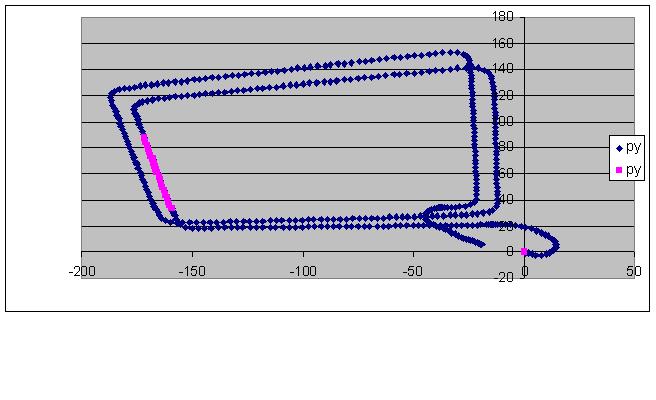
I changed my data logging format so I don't have a copy of the DR trace from my first DR run around the local building, I'm posting one from Sparkfun instead)
Here is a DR plot of two laps around the spark fun building Thursday night.... I drove from where my car was parked in the street out front and went around the building twice...
The DR was almost good enough to to the task all by itself.... I was off about 15ft per lap.
I then started setting up Garbage cans in my drive way and using the LASER range finder to dodge them while staying on course.... I learned that having the laser scanner rotate 90 degrees
to look ahead while also measuring the side range for navigation was problematic. It was fast enough, but the timing of the servo drive and the main command loop were asynchronous enough that I was never really sure where the scanner was pointed and could not properly associate range results with what heading they were on... As I planned on having spare of most everything I then took my spare range finder and mounted it 90 degrees to primary range finder... so now I had two range finders
This was the final physical I/O configuration...
3 RC channels from RC receiver in to timer channels.
8 RC channels out through a shift register using a timer channel.
USB serial port for talking to dev system,
1 Serial port for receiving data from the IMU (A DIY Drones IMU board)
2 Serial port for receiving data from the Laser scanners.
1 Serial port receiving data from the Sparkfun Venus GPS.
1 A/D for measuring the Odometer.
1 DSPI talking to an micro SD card for log data
So then I modified my simulator to have two Laser ranges...
While using the laser range finder to map barrels in my drive way I
accidentally launch the car down the drive way.... still attached to my
laptop thus ripping the ethernet jack out of the back.
Ebay to the rescue I got a super rugged lap top from Ebay three days later I had the joy of moving all my tools and code from old laptop to new laptop with out the benefit of ethernet.
I am now very much running out of time. On Tuesday the data from the side laser range finder is really flaky So Wednesday Morning I order another range finder so I have a spare and have it shipped to my hotel room in Boulder.
Wednesday night I go back out to my nearby test building and drive around a few times collecting data. I then spend Wednesday evening fine tuning my data reduction method. For my rocket project I'd written a custom data display application and that was a huge effort. As this seemed to be a simpler project I used a different approach...
The logging was almost identical, IE I logged everything. I stated out by logging to the SD card, but managing file names and when to flush the buffers etc... was a hassle, as I have 64M of available RAM I just logged to RAM and then at the end of the run FTP'ed that data set to the lap top. Quicker and easier than the SD card in this case. For a vehicle that might physically crash such as an airplane or helicopter, or rocket my strategy is to write to the SD card physical sectors directly so the data is always fresh, in this case with the car it did not really apply so I just left it in RAM. (More on the cost of this decision later)
So to reduce the data I wrote a program that would convert the binary log file in to a CSV file and look at it with excel I could do linear plots and scatter plots etc... worked, well but it was slow as to add plots or graphs I had to manually go though the excel interface and add charts...
I eventually figured out how to highlight specific ranges of the data on the scatter plot giving me the ability to tie a specific piece of data to a specific physical location. (See the DR plot above the Pink is a highlighted section of data. Properly viewing multiple rate data is (for me) an unsolved problem.
My Rocket display code worked well, but it was purely linear display, no way to tie the data to a physical location or map. I should probably write something to permanently put in my toolbox for this as its a thorn that keeps poppoing up over and over... either that or learn to wrote VBA code for excel.(yuck).
So Wednesday night I pack up everything, all the spares the car 4 sets of laptop batteries, etc...
I only had one set of Lipos for the car as I was concerned about bringing big Lipos on the plane so the previous week I'd sent 3 sets of Lipos for the car to my hotel in boulder UPS ground.
Soldering tools, a spare everything....
(About 6 pm Wednesday I realize that while I have a spare IMU its got the wrong code in it, so I make a trip to my office where the code load for the IMU Was and reprogram the spare)
I get to bed by midnight or so... and leave the next morning at 5:30 am to catch the plane.
My flight leaves at 7:45 but I'm checking and carrying a lot of strange bits and pieces so I want to allow lots of time. The check in goes fine and the security line is huge, I have my wife waiting in the waiting lot to take the Lipos from me if they don't clear security.
Good thing I had her wait as I go through security it dawns on me I've only gotten three of the four boxes and bags I needed, and I left one in the trunk of the car.... I call her pick that up and wait in line again. Security lets me through.... does not even glance at the 4 laptop batteries or the 3 Large Lipos in my bag.
I arrive in Denver and go to get my rental car.... I have a reservation alas the previous week there was hail in Denver damaging more than half of the rental car fleet. it takes four hours to get my car. There were people in the back of the rental car line that had reservations for a car and weren't going to get a car. There just weren't enough available...
So I drive to boulder, eat some lunch and check into my hotel room. I unpack everything and assemble the car. I drive it around the hotel parking lot to make sure that all of the sensors are working... and head for Spark fun... its clear that they are setting up for the AVC, but there are too many cars in the parking lot to take any useful data to I walk around mentally looking at things and go back to my room. I return to Spark fun around 9 pm that night after all the Spark fun people have left and I'm one of three cars testing at Spark fun.
I drive the car around the building a few times recording all the laser ranges and GPS.
the side facing Laser range finder is still flaky even after swapping out the unit.
So I point the good laser range finder to the right and take two more runs around the building recording that.
I go back to the car make sure I've captured good data and go back to the room.
I get to bed around midnight and get up at 6:15 Friday morning.
I reduce all the data I took into a set of GPS coordinates and a set or range heading and odometer readings. In the last week the AVC project has destroyed my training schedule for the Half Ironman I want to do on my 50th birthday in September , so I use an hour or so to clear my head and get some exercise. At around 9 am I go find the Boulder recreation department public pool and swim about 1.5 miles. Side note swimming is usually a bit hypoxic to begin with, swimming at 5000+ ft of elevation and at fast training pace is hard...)
I go find Lunch and then head back to the room. There is a big empty parking lot that is blocked from traffic near the hotel. I'm not sure what it was for, but it had barriers at the entrance and a bunch of light poles with big concrete bases that were goo barrel dodging simulations.
For practice I drive around four poles and reduce that data to a program that would navigate around the barrels using the barrels and laser range to find the corners... This is working well and then I start testing the barrel dodging code and it all stops working.... it seems that I let the primary battery get too low and the Laser range finders all lost their calibration ARGHHHH! Its now 2 pm and Spark fun has a tour at 3PM, I really want to take the spark fun tour so I drive out to Sparkfun and take the tour. Back at the hotel at 4:30 pm and work on re calibrating the Laser range finders.... I decide to switch the laser range finder to raw count uncalibrated mode and just use raw counts an do the cal myself...
Here I realize what is probably Strategic blunder #0 assuming that other embedded programmers did their job. The Data sheet for the Laser range finder says accurate to +/- 1 Yd no mention of resolution, yet the data print out in Ft mode was DIST:12.3F IE it had lots of resolution, or so I thought... it seems the absolute raw resolution is about 0.5 yd's and the data after the decimal point was 100% meaning less. I had much less resolution that I though I had and finding the arch based on this distance was going to be dicey....
I'm now really worried that the Laser range finding navigation scheme is not going to work at all.
So I do what I should have done weeks ago in San Diego, I write the GPS following code to have a back up plan. I go out to my test parking lot and take GPS coordinates and test this code I successfully drive around and around the parking lot using GPS. It works real well and is more accurate in the open parking lot than it was near my test building.
So at this point its about 9pm and I have a Laser nav program and a Gps nav program set up for Spark fun... both untested on site.... I stop at McDonalds get a burger and a very large Ice tea caffeine supply and proceed to Spark fun.
There are about 5 groups driving around the building with their car.
Between 10PM and midnight I see one group drive their car into the pond twice.....
The first half of the course works well almost immediately....
Finding the first corner is a bit dicey and the spark fun people have put up 2" diameter posts with a 8" diameter base all around the building on the edge of the sidewalk. The laser scanner keeps catching glimpses of these and thinking its too close to the building and as a result it heads for the pond..
My RC kill switch is fast and I save it several times... So I tune the algorithm to take 16 point averages and only use the ranges from the highest 8 or so readings... I also start setting up exclusion zones where the system ignores the laser and just drives on heading... for some fixed distance.
My first around the building state machine had 8 states...
Numbers are odometer counts, reset means set odo back to zero...
/*
DR Version...
//Heading 85 deg Wall follow at 25 ft at 750 arm
//Hold heading till distance jumps by 20 ft
//Then coast 300
//Then turn to 167 Reset Odo
//Then coast 100
//Then follow wall at 28 ft till odo 2000.
//Hold Heading wait till distance jumps to 35 reset odo
//Coast 600
//Then -105 Deg reset odo
//Coast 200
//Wall follow at 42 Arm at odo 1100
//Hold Heading wait for Jump to 52
//Turn to -18 deg Reset Odo Coast 100
//Then wall follow at 20 ft. Arm at 2200
//When distance goes to 30 fto turn to 85 deg
//Coast 100
//Wall follow at 25 ft till odo 1200
//Done.
*/
I have two problems, First the parking lot is not flat, in some places its enough not flat that the car tips enough that the side laser scanner (still being flaky) points at the ground not the building....
So with a bit a cardboard and tape I re point the laser scanner up about 15 degrees.... things get much more consistent.
I keep having a problem with the third turn, no tuning I do seems to make it work. Its now about 2am and I'm at less than peak performance....
So I switch to my GPS code and tune that a little, about 8 tries later the GPS version drives around the building, but in the next three attempts it only works 2/3 of the time. The variance in the low cost GPS is just too much... I save this code as a back up and go back to laser scanner mode...
I immediately see what my issue is I forgot a break in a case statement, so no matter how much I told it to extend out the third turn it just went to the next state turn ... I fix this and a similar copy and paste error two steps later. Next attempt it extends the third turn out way too far and changing this back and now we make it almost all the way around the building.. Fix up the forth turn and we finally make it all the way around the building autonomously with out error. We do this twice more...
I've been runnign after the car all night to see what it is doing. so its speed is set to as fast as I can run... as the night wears on the speed gets set slower so I can keep up.
So I turn the speed back up start the car, watch to make sure it gets past the pond and then I go back the other way to see it come out... no car....
I find it in a bush very far from where it should be....
I try again same result slightly different bush...
I turn the speed back down to where it worked...
Its in a different bush...
So I now run after it.... it works perfectly....
Again I run after it works perfectly.... my knees are starting to hurt from doing wind sprints all night...
I try to launch it and not run after it... strange bush... doesn't work.
Then it dawns on me... when it looses sight of the RC transmitter the RC receiver goes into fail safe mode and stops the car... then when I come looking for it it sees the RC transmitter before I see it and the RC Tx is still in autonomous mode so the car sees this as a manual -> autonomous toggle and starts thinking its at the beginning of the course!!!!! ARghhhh! So I turn the speed up a little and walk ahead of the car as far as I can still retain manual control.... I then start the car and run as fast as I can and it goes around the building... whooo its all working.... then the laser scanner stops working at all!!! Its starting to get light and the first person to show up around 5am with their car says to me early morning or late night.... I make some kind on unintelligible response and one look at me makes him worry that the zombie apocalypse has come to Boulder....
The flaky Laser sensor has felt like bad wiring from the very beginning, if disassemble the housing and hook it directly up to the laptop serial port and power it with an external battery it works every time. I've pulled tugged, and re soldered all the wires from the LASER range finder back to the dev board about 2000 times and can never find a bad connection.....
It starts working again.... but in the process I break the glue joint on the mount....
So I need some glue to re glue the mount and ask the spark fun people (now here setting up) where to find a hardware store and breakfast near by... Or where can I find power to use the Hot Melt Glue gun in my took kit ... They turn on power to the pits area and I hot melt glue the laser scanner mount back together... laser scanners are not both working...
At this point the 4th laptop battery is dead and I go to my car to get the charger only ot realize its in my room at the hotel...
Into the car and drive back to the hotel stopping at the same McDonald's to get breakfast.
Get the charger, change my shirt and try to wipe the grime off my face and hands...
Back to spark fun... its now 8:30 and the contest starts at 9.
I charge the laptop and put fresh Lipos on the car. Sitting on the bench test everything the side laser scanner is not working again... I see a loose wire on the board... The carrier board I'm using only has level translators for one RS-232 serial port. The IMU and GPS are TTL levels, the laser scanners are RS-232 so to get around this I jumper the CTS in line from the one port from the CTS pin to the RX pin on a different serial input (The board has 8 serial ports pinned out) My flaky wiring for the side laser scanner was a bad crimp on the jumper from the CTS to the RX pin... not on the external wiring at all. I fix this and never again have a laser scanner problem for the rest of the day.
I turn the speed down to the speed I can run and the first heat goes reasonably well... we make it 3/4ths of the way around the building the light has changed and now the laser scanner can see through the window on the last turn, it sees this jump in range and thinks the corner of the building has passed and turns into the building....
So I extend the lock out range for corner detection and on the second heat still in slow as I can run mode we make it all the way around in 1:06 We miss the arch so no arch bonus...
(I think this run was good for 4th or 5th place)
This photo was taken by my Friend Ben Brockert (@Wikkit) between the 2nd and third heat.
The last heat... I turn the barrel dodging code back on as last time we just plowed through the barrels... I turn the speed way up and change the code to ignore the RC receiver after going into autonomous mode..... The car hauls down the straight, properly dodges a couple of barrels go straight through the arch and around the corner I run to the other side and it never comes out....
So I walk back and find it in my favorite bush at this point the competition is over and I have a choice... I can carry the 20lb car back to my laptop and download the data log to see what happened... or I can hit reset and manually drive the car back and loose the data log never knowing for sure what happened on the last lap.... I'm tired I press reset....
I've now flown the canard finned nose cone, three times...
On the first flight I had the accelerometer sensitivity too high, but the roll sensitivity was fine.
In all hte following plots roll is red, and vertical acceleration is blue. Flown with a CTI L800 blue
We had ever increasing roll as the flight progressed, no evidence of any control
So I changed the acceleration scale and removed the fins, leaving everything else unchanged...
(Slightly differnt motor CTI L820 Skidmark)
The roll was in the same direction and of lower magnitude than the controlled attempt....
Then I re flew with the fins attached and the mechanical throw increased about 50%.
Again with a CTI L820 Skidmark.)
This flight almost looks like it worked, ad the roll was controlled during the early boost phase of the flight.
Either I have weird aerodynamics or I need a lot more control authority.
Its possible this last flight worked as designed until it got close to Mach 1 and saw shock wave issues.
The altimeter reported a maximum velocity of 1150 ft/sec or right near Mach 1.
In going out to FAR I've seen a whole bunch of beautiful rocket projects crash and burn due to recovery failure. Less than 25% of the liquid flights I've seen have had successful recovery. I don't want to repeat this so I set out to learn recovery from the HPR guys that routinely recover their vehicles. Part of that was building and flying my own level 3 HPR.
On Saturday I went out to the local Tripoli HPR launch and flew my L3 qualification flight. I don't have a whole lot of pictures, but I have a few bits of data..Its a MadCow DX3 Massive Kit, I flew it on a CTI M1450 . The flight was a complete success 15587 ft altitude dual deployment with 24" drogue at apogee and a 96" main at 700 ft.
I learned some things about doing recovery in the process, some minor details, like swivels and shock cord sizing and protection. How to properly pack a parachute etc... hopefully I can transfer this knowledge to my next liquid project.
John Added a 4" section in the tank mold and blew another bottle....The test was a success. This adds 30% more volume and no more liner weight! Based on best guess....this pushes the 1000PSI MR to close to 22 and 500 PSI close to 28. We will have real fully finished tank numbers shortly.
One possible solution for a light weight tank is re blowing a PET bottle. The first experiment in that direction was a success. Based on preliminary calculations and carbon overwrap it looks to generate a 1000 PSI burst tank with a peroxide MR of better than 19 and a 500 psi burst tank with MR of better than 25. (Water MR would be: 15 and 20 respectively.)
You can see where the thermocouple measuring the bottle temperature left a mark on the bottom...
The world is changing, the internet is providing a level playing field that spans the world. Hacker spaces, distributed group projects, crowd sourcing, crowd funding, social media, internet based print and media publishing etc... Like minded people can group together and accomplish wondrous things.
For awhile I've been thinking that this energy could be harnessed to create a space/rocket project. I recently read that Copenhagen suborbital has a a subscription model. Kickstarter recently had its first $1M project. Armadillo aerospace started as a volunteer group. (with serious outside funding from John's video game success. ) Reality TV shows like orange coast choppers or junk yard wars show the media value of people tinkering with interesting projects..
My goal is clearly to build a NANOSAT launcher class vehicle.
What would a successful crowd sourced effort look like?
I'd like to do this in as open and public way as is possible with out going to jail (ITAR).
If I publish all the information along the way do I destroy the business case even if I'm 100% successful?
How would one get more people involved in the project?
How many people in the San Diego area would sign up for working one or two evenings every week and two Saturdays a month for a year(s)?
Anyone volunteer to be video guru and/or webmaster for such a project?
My personal ethics code would find it very hard to take $$ from the environment without explicitly giving something back? I could start taking deposits for future flights and try to do funding that way, alas this makes me really queasy as there have been space efforts generating press releases and taking deposits where the underlying organization has not fired a rocket motor or built a flying vehicle in more than a decade. Some of the efforts cross the line where its either outright fraud or serious delusion. I hope to never fall into this category.. For those that are new to my blog and my efforts take a look at this video starting at the 8 Minute point
If I did a kick starter project what would would be good collateral to offer for different funding levels?
Fly your business card to space?
A discount on future Nanosat launches?
Guest passes to watch launches?
Shop tours?
Weekly two way video chats?
Access to live shop web cams?
Early access to blog and video posts (1,2, 4 wk delay from post to public release?)
Bits of hardware.. IE the actual GOPRO that took video from space with the origional SD card and unedited video.
Access to data?
Any thoughts on a subscription supporter model?
If I did this what value could I provide in return?
Is information/ blog entertainment enough to give back?
Any possibilities of doing some kind of reality TV program either web based or not?
I'd really like honest feedback from everyone on this. The most realistic response might be the observation that I'm completely certifiably nuts... My favorite recent joke is the one about the guy that goes to the hardware store and asks for "slightly neurotic glue" as he doesn't need full strength "crazy". For what I want to try to do I'll need full strength crazy and then some....
I had someone ask me to update my blog.... Its been awhile, I have not been idle and this post is probably going to be 95% unsatisfying as I have no cool rocket pictures, videos, or time for the kind of detail I've normally done.
First one must sharpen the saw. If one cuts wood for a living one must take time off from time to time to sharpen the wood saw otherwise everything goes badly. My saw is my ability to think and work hard. Over the three years since the LLC I've felt generally yucky. I've talked about my battle with motivation depression and project decisions etc...here on the blog. I felt tired old and run down. so for the last 7 months I've taken a real active approach to fixing that.
I've gotten my physical self in order, I feel more energetic, sharper and generally I feel ten years younger than I did a year ago. I'm sleeping well, I'm beiing creative and getting projects done. This has not been an easy thing to do , I've lost 52 lbs and done a 100% change in my diet and exercise behaviors. This takes a lot of time I'm currently exercising about 7 to 10 hours a week.
After doing this for awhile I'm finally getting to the point where my body is getting used to this and I have the energy to start working on interesting things. Its only been in the last 60 days that I've had the physical energy to start working on projects and things beyond the day job. Here is before: Here is now:
NetBurner All the cool rocketry projects and other things on this blog are made possible by my success with my primary business NetBurner. This is the source of all funds and its success enables the freedom needed to work on Rockets. In 2011 Netburner had a record year, out best ever. However my 3 year lethargy and funk has left a bit of a product hole that needs to be filled. I'm in the middle of releasing several new and cool NetBurner projects and fixing some missing product line pieces. This has to take precedence over the rocket stuff.
On To rockets: Recovery: Out at FAR I've watched countless cool rocket projects crash and burn due to recovery failure. Recovery has to be learned, so toward that end I'm working to learn recovery in the traditional HPR sense. Last Saturday I flew my very first electronically triggered dual deployment HPR and it was a 100% success. Next Month I'll fly my slightly bigger L3 project. This L3 project is about the size and weight of the next liquid rocket I'm going to build so it will be a good training ground.
Guidance Electronics: There are a number of cool things going on in MEMS solid state sensors. From high precision stuff from analog devices to really low cost stuff from ST micro. I've build a new tiny 50gm autopilot that uses some of these sensors. The first version had some issues and the 2nd version is sitting om my desk as a pile of parts awaiting assembly. I hope to fly both a rocket and the helicopter with this new autopilot in the next month.
Aerodynamic guidance: A while ago I posted some pictures of some canard control fins I was going to build for an HPR. I got some feed back and did some studying and learned that for super sonic flight this is just plain not going to work as the shock waves will interact badly. Toward that end I've been looking at putting some tiny trailing edge fins on my L3 project and doing guidance that way. The flometrics (girls and guys thanks Judy) have been helping with some detailed transonic CFD to help with placement and fin shape to make sure the shock interference does not negate control. Here is an animation of the pressure... We have done several rounds of simulation and will continue with this effort. The L3 rocket does not get guidance and stub fins until after I fly it for my L3.
I am going to finish the canard fins project and fly it with the following rules: If we are subsonic active control... otherwise center the fins. I hope to fly this with just roll control operational a week from this Saturday. I'll try to get some pictures up of this vehicle.
Tanks The project to build composite flight weight chemically compatible propellant takes is ongoing. We have had real inconsistent results, some tanks work and some turn out very brittle. Our resin vendor has basically burried their head in the sand and stopped responding. I'm 90% sure that they have a production QA problem with their resin as the difference between the 1gal sample and the 55gal drum of the same stuff is night and day. I'm also 98% sure that the 55gal drum does not meet the specs on their data sheet. A most frustrating effort. Toward that end I've been working on several liner approaches that will allow us to build tanks with resins that we are structurally comfortable with. I hope to have results on several of these efforts "Real soon now"
Rocket Motors: I have a very light weight innovative design idea for a new Regen rocket motor. I'm building the first version as a 500lb thrust version and I home to have the prototype for show and Tell at Space Access in April.
Business As I've said several times here and else where building a sat launcher is all about weight. In basic complexity it can be less complex than a full reusable VTVL rocket that the other LLC competitors are working on. If my ideas for low cost light weight structures, innovative pressurization and light weight motors all work then I think I have a pretty solid business case for a profitable launcher business.(Starting with a proof of concept nanoat launcher) The real question is do I want to go get funding and accelerate that project or do I want to just keep using discretionary $$ to slowly work up to that level.... I hope to have a lot more info about this mid year or so.
The Saga of the humming birds, too tired to get pictures and video I have of the before conditions together. Will do so later.
A Humming bird builds a nest in our front entry way on fragile shrub right in path of traffic. So we put a step ladder in front of the nest with a sign that says go around watch out for nest. All is well for a while, the mom and dad bird tend the nest and the eggs hatch.
Last night when we came home around 8pm the fragile branch failed turning the nest upside down. Dumping one baby out on the ground, Mom bird was frantically buzzing around in the dark bumping into things. We righted the nest and taped it to the ladder to keep it upright
Mom did not return to nest so we tried putting here back on the nest she did not stay, she flew away. After 1/2 hour with temp in low 50F we brought the nest and one baby bird inside and placed them in a large Christmas cookie tin. Put tin floating in pot of warm water (bird stayed dry, tin floated on the water.) Put a small thermocouple on the nest and regulated temperature manually to keep it around 90F all night. Not much sleep for wife and I, after getting this set up we decided to go back outside a look for second bird not in nest, found bird on sidewalk, very cold and barely moving. Brought it in warmed up and put in nest.
Fed some sugar water to both babies. (I know they need protein too, its all we had) Stayed up all night, at first light Put Christmas Tin with nest in it on top of ladder under bush where nest was.
Mom came by, got in nest fed fed baby. Then pecked side of Christmas tin flew around wildly and flew off. (All this activity was observed 10 or 15 feet away from inside through window)
Replaced tin box with a piece of wood with a hole the right size for nest to sit in.
Dad bird came by and fed both babies off an on all day. Never saw mom again, but did not keep a close watch. This afternoon we went by the backyard bird store and got some humming bird food with insect protein in it.
Tonight after dark we check the nest, no one is sitting on the nest, no mom, no dad, getting cold again down to 55F not sure what to do brought nest back inside. Went and got small heat lamp and have the heat lamp shining on the nest with thermocouple in air next to nest under heat lamp. Will stay up long enough to insure that temp has sabilized then go to bed.
Current plan is to return the ladder and nest to its correct spot just before daybreak in the morning. Hopefully dad bird will keep feeding them.
The babies have their pin feathers and some more substantial feathers on wings. but don't seem to have their eyes open yet. Not sure when they hatched. Not sure if this is the best course of action....
From a philosophical stand point, it's just a few grams of almost inconsequential bird feathers, In the scheme of things would I be doing a more significant service to nature/GAIA if I let the little ones die and did not burn resources driving around gathering things to try and save them? I've spend $ and time that might remotely make sense if I were a vegan (I'm not). How can I in good conscience eat an animal that is smarter and closer to me in the scheme of things (Beef) and at the same time spend a sleepless night and a good part of this evening helping a tiny bird that may or may not survive and in any case will not understand my efforts?
A tired brain can barely ponder such things.
Morning Update. I've been told by a Humming Bird expert that Mom does not sit on the nest after 5 days or so. So Not having mom on the nest at night is normal. I put the nest back out this morning and have seen Mom feeding them at least twice. I captured some poor video of her feeding them here
I changed the camera angle and its recording, sometime tonight I'll go through the hours of video and try to post better pictures.
I've also been told that "Dad" is a threat not a helper. Here is a picture Mariellen captured of "Dad" on the nest the day before it fell down.
The LLC hovering vehicles were fairly simple to model. Fixed local frame of reference, constant air pressure, fixed magnetic dip and declination all in all slow enough that one could basically ignore air drag. One could model the vehicle dynamics using a simple unchanging world in Cartesian coordinates.
I've spent the last 2 years thinking about what it takes to build an orbital vehicle. A very rough first pass can be done with a simple how much delta V do you need. A more refined tradeoff needs a more refined model. Ultimately I'd like a full up hardware in the loop simulator that I can run full missions on. Writing such a simulator is a bit of a daunting task.
Just modeling the complexity of the "World" as you fly around it is non trivial. Starting with what reference frame do you use: Lat Lon altitude? , North East Down? Earth centered fixed. Earth centered Inertial? (Probably ECI what epoch J2000?)
A whole bunch of things that used to be fixed for the LLC simulator now change...
Gravity,
Atmospheric pressure.
Magnetic field strength, direction.
GPS constellation geometry.
Earth is not round.
One could refine the vehicle model with a simple 2D model of a spherical earth and launched from the equator, Yet there are questions that can't be answered without these details. Just one simple example, I plan to use a MEMS IMU, GPS and Magnetic sensor to keep track of the vehicle position and orientation. MEMS IMU's drift really bad (0.1deg per sec is typical for a mems gyro) A better Laser gyro is much much heavier.
This is correctable if you have a couple of outside references to keep things aligned. In aircraft its common to use gravity and magnetic field to "erect" the gyros keeping then aligned. On a spacecraft under thrust you can do it with GPS velocity an accelerometer and a 3D magnetic filed sensor. The accelerometer measureing thrust direction in a body frame is compared against the GPS measured acceleration in an absolute frame (Say ECF), In reality these two vectors measure the smae thing so these two vectors gives you one absolute orientation vector. The magnetic field gives you another. This will fully define the corrections you need to apply. If some where during your launch the magnetic field vector and the desired thrust vector align too closely then you really only have one reference vector and your orientation is ambiguous in roll around that one vector. You might say that orientation on that axis does not matter, and that would almost be true, but if the orientation changes from the desired trajectory and you want to correct back or close the loop, you must have a full orientation solution to steer the rocket.
So do they ever align? I have absolutely no idea. Does this mean I'm limited to picking only certain orbits? Maybe? When the rocket stops thrusting and coasts I loose my orientation again, can I start thrusting for a circulization burn and learn my orientation quickly or is it more efficent to steer into a direct injection orbit with no circularzation burn.
Doing a direct injection burn has a delta V penalty, is this penalty larger or smaller than the hardware weight cost to have the 3rd stage motor restart? Is the find my orientaion with quick thrusting penalty in delta V greater or less than the mass penalty for a simple sun sensor, or tine CMOS start tracker? Inquiring minds want to know. The whole conceptual rocket has way too many knobs.
Beyond modeling the world you have to model the vehicle and its systems. Tanks, valves, actuators, pressurization systems, rocket motors, thrust vector control, atmosphere drag, aerodynamic moments, areo and solar heating etc.. etc...
Trying to organize this monster project into a modular individually testable coding campaign is quite daunting.
For the last two months I've been working on improving my physical self. Next year I turn 50 and its clear that some attention to self maintenance is no longer optional. I've been running, carefully controlling what I eat looking at things like nutrient levels unrealized food allergies etc... So far I've lost 25 lbs, I am sleeping better, fixed some weird digestive issues etc... I'm starting to feel a whole lot better. For the next few months this is going to remain my primary focus, but I'm starting to have some spare brain cycles to devote to interesting projects. The only problem is I have not yet picked one. Its almost an embarrassment of riches as I have far more things I'd like to work on than I could ever possibly do.
Here is the list of what I've spent some time on in the last three months:
Exploring the possibility of starting a Nanosat/Microsat launcher business.
Exploring the NASA NanoSat challenge.
Working on developing peroxide compatible high performance tank age.
Training my self to run, I'm up to running 5K, long term goal is to finish a 1/2 Ironman, the swim and bike are much easier for me that the run part.
Learning to be a better RC helicopter pilot.
Updating the Helicopter autopilot to clean up code and use more modern lower cost sensors.
Helping my Son move to Seattle and getting adjusted to the "Empty Nest"
Testing GPS units under high acceleration.
Cleaning organizing my Shop in anticipation of getting back to a rocket project.
Repairing my little catamaran and doing some delayed maintenance on the boat.
Going to the shooting range and relearning to shoot well. This was the primary Father son activity with my Dad from age 8 to 16. Sad to say that I took my Dad to the range and he is too far gone down the dementia path to enjoy that, it was loud and confusing and he realized he was not shooting well, but could not put the cognitive skills together to figure out what he was doing wrong, one of the Sadest things I've done in a long long time.
Here is the short stream of consciousness list of projects I'd like to do, and that I've spent some time sketching or thinking about.
Develop a tiny low cost guidance and control package for HPR class rockets.
Develop a truly low cost (<5K) hovering controlled rocket vehicle for use by students, schools, serious amateurs etc...
Develop an autonomous aerobatic RC helicopter.
*Develop a integrated RC transmitter and Telemetry receiver display for UAV and controlled rocket use.
*Develop a gas and go 100Kft reusable liquid rocket. (Glide back, guided parachute, or VTVL TBD)
Get my FAA medical back and start flying again. (13 months ago I started using CPAP, so without a lot of paperwork and hassle that pretty much kills my medical.)
*Develop a peroxide rocket that uses thermal decomposition rather than catalysts, allowing 95% peroxide and removing cat pack black magic issues.
*Develop the full range of motors necessary to build a nano-sat vehicle.
*Build a electric "turbopump" driven rocket motor.
*Do more development on 3d printed rocket motors. (This is really a $$ issue)
*Build and fly a two stage liquid rocket.
*Build out and test the paper concept I have for a very simple to construct Rocket Motor.
*Develop a set of compact brushless valves and actuators and Sell to NewSpace co's.
Build, test and sail a trans pacific autonomous sailboat.
Build a large envelope 3D printer IE a Makerbot on steroids.
Start something like Techshop in the San Diego area.
*Start something like the original Armadillo aerospace setup. IE get a building and have a group of volunteers working on some serious rocket projects with meetings/work parties twice a week or so.
*Start a properly funded venture funded rocket business.
Do some more public speaking. (I've really enjoyed the speaking I've done)
Build and market an RC helicopter "Oh Shit" Autopilot, IE a small box on an RC helicopter that will recover from dumb thumbs and put the vehicle in level hover if you screw up and hit the Oh shit button)
Do some more traveling and see parts of the world I have not seen.(South America, Asia)
Buy a big sailboat and take a long cruise.
Everything with a * is applicable to the NanoSat challenge.
The original tank shown in the last blog post did not pass hydro it failed at about 180PSI where the integral liner failed. This tank was desiged for 500PSI burst.
So the second attempt used a slightly different process for the liner. The liner actually turned out lighter, but it was so light that is started to buckle during the overwind process. We were targeting a 1000 PSI tank this time and the logitudinal windings for 1000 PSI were done, but the tank started to buckle after only about half the circumference windings. When this happend the tank was removed from the winding machine, slightly presurized and put in the curing oven.
Based on the partial winding the tank theoretical burst value was just over 500 PSI. Today the tank burst at 500 PSI. There appears to be general stress all over the tank, but the failure was fairly catastrophic showing that the fiber matrix was distributing the load correctly and the failure was not a point failure. All in I'm very happy about this result.
With 85% peroxide the tank that just failed at 500PSI (Even with double the needed longitudinal windings) has a mass ratio of 36!!!!
We are about to make tank V3 and will modify the fixture so we can slightly pressurize the liner while winding.